Japanese
The Japanese learning community is incredibly resourceful, and it can be quite daunting for a beginner to know where to start.
My intention for this personal section of my site is to contextualize various resources scattered everywhere and record a heterogeneous learning method to make sense of Japanese.
I don’t really have any plans to make this into a thorough and comprehensive repository, just a place to dump all kind of scattered resources.
For a quick primer, read Japanese Primer.
Interesting things to read
- Japanese Frequently Asked Questions
- If you’re looking for a good starting point to learn Japanese:
- To improve your conversational Japanese:
- Collection of Japanese Phrases Your Textbook Won’t Teach You
- Series of articles if you are interested in the Japanese writing system:
- Some tips to help make sense of Japanese:
- Various Japanese learning resources
- General language approach philosophy:
NOTE
This entirety of this Japanese section and all the contents within is credited to Morg Systems. I plan on using this section to serve as a resource hub for myself on my Japanese language learning journey.
All Japanese Notes
- Kanji
- Ateji
- Furigana
- Gikun
- Onyomi and Kunyomi
- Japanese Frequently Asked Questions
- Japanese Primer
- EJLX
- Anki
- Migaku
- Refold
- Learning to Output
- Unlocking Japanese Tricks
- Practical Tips to Facilitate Early Reading
- Optimal Reading Immersion - Narrow Reading
- The Science of Letting Go
- Collection of Japanese Phrases Your Textbook Won’t Teach You
- How Do I Pronounce This Word
- How Do I Read This Word
- How Do I Read This Math Expression in Japanese
- How Do I Look Up the Meaning of This Kanji
- What Does This Word Mean
- What Does This Contraction Mean
- What Does This Particle or Grammar Structure Mean
- What Is the Counter for This Word
- What Is the Difference Between These Two Words
- What Is the Difference Between This Word Written With These Two Different Kanji
- What Words or Particles Should I Use With This Verb
Japanese Primer
If you're confused by the huge amount of resources and options available to you
Japanese Primer
If you’re confused by the huge amount of resources and options available to you and just want to learn Japanese, here’s what I recommend.
READ THIS FIRST:
FIRST:
THEN:
Learn Grammar + Vocab + Kanji
Do NOT skip ahead, do kana first. Japanese will still be there after you’re done with them don’t worry.
Grammar
-
Read Sakubi if you value independence and just want to read native material as soon as possible.
-
Read Genki if you want a textbook.
Vocab
-
Grab a core deck and start learning core vocab. My recommendation is to get the N5 and N4 ankidrone starter pack decks (first do the N5, and then the N4 one).
-
Once you’re finished with those, start sentence mining.
Kanji
You don’t need to worry about kanji, they can wait for later. Focus on learning vocab (words) and you will learn to recognize kanji as you go. You’ll figure out what to do about it later, trust me.
It is much easier to learn kanji if you already know a lot of words, so just learn those words. No need to rush it. Read stuff with Furigana at first so you won’t have to worry about it. Use yomichan to read on the web. See also: Practical Tips to Facilitate Early Reading
Extra
- Bookmark Japanese Frequently Asked Questions and Unlocking Japanese Tricks and read them every time you are confused about something.
- Read Japanese Learning Loop if you want a more general overview.
- Read Japanese Resources if you want alternative options to the resources mentioned above. I also go in more details about each of them.
- Read e50a5ae3 if you’re looking for something to read that might suit a beginner.
 Remember! Good luck and have fun!
NOTE
This is just my personal opinion. There’s no best way: what works for me might not work for you. Don’t stress it, if something is not working out then use something else.
Japanese Learning Resources
This is a mostly scattered collection of sites, tooling, and all kind of things
Japanese Learning Resources
This is a mostly scattered collection of sites, tooling, and all kind of things that can help you learn Japanese.
Comprehensive Guides
Itazuraneko
4chan’s /djt/ (Daily Japanese Thread) guide. I don’t think it’s very beginner friendly but it has a lot of content and sections for all kind of topics on how to learn Japanese.
Refold
New approach to MIA (see point below). The core ideas a pretty much the same as that one, really.
Mass Immersion’s Approach
MIA’s specific quick start guide on how to study Japanese using the 4f5f4e00 tools and resources. MIA’s focus is on extensive immersion and natural acquisition of the language. It is worth checking out for the amount of resources they have mostly related to Anki but ever since the split most of them are under the Migaku umbrella now.
Awesome Japanese Beginner Guide
This is really a collection of various tools, textbooks, links, etc (similar to this very own page). It’s a collaborative project from various people at the EJLX# discord.
r/LearnJapanese Beginner Wiki
The official beginner’s wiki for the Japanese learning subreddit.
While personally I would not recommend spending too much time on the subreddit, their wiki is a decent entry point before branching off in your studies.
Wasabi’s Japanese Self-Learning Guides
Wasabi-Jpn is a site/project with a lot of resources for people learning Japanese. Among them, there is also a self-learning guide.
I personally haven’t gone through the whole guide myself, however I have read a lot of the articles. The way they expose the grammar seems to be solid to me, however I have noticed a lot of English mistakes and weird explanations. They do not make understanding necessarily harder but they can be a bit weird to parse at times. Your mileage may vary.
Textbooks
Genki
The go-to de-facto textbook for Japanese beginners that want to learn in a classroom-like setting with structured lessons and workbook exercises.
Pretty much everyone will tell you to get Genki if you want to start learning Japanese. Personally, I’m not a big fan and I prefer the Japanese for Busy People series, however I seem to be in the minority.
Japanese For Busy People
Another textbook like Genki with a classroom-like lesson structure. It covers about the same topics as Genki, and personally it’s what I’ve used myself. I would recommend it over Genki as I found it to have a better format, but overall they are very similar. Get the kana version, don’t even bother with the romaji one(Japanese Writing Systems).
Japanese the Manga Way
This textbook is very interesting to me. It attempts to provide some kind of crash course to Japanese grammar by real world examples of manga snippets. It’s great for beginners and covers a surprisingly large amount of grammar condensed into a relatively low number of pages. I used it mostly to learn basic particles and sentence structure as a beginner and it carried me a long way, surprisingly.
An Introduction to Modern Japanese
Relatively old (2004?) and hard to come by textbook. I include it here because albeit extremely expensive for what it’s worth and hard to find online, it provides a very “different” approach to modern Japanese learning practices. The book itself is very intensive and is not afraid to jump into complex Japanese from the get go, every chapter is introduced with a quite meaty block of conversation/text to immerse in. No furigana, extensive use of kanji. It definitely does not hold a beginner’s hand through its material, but I found it to be very interesting and appreciated it for what it is.
Definitely not essential, but if you can get your hands on a copy as a side read it can be quite an experience.
Tobira
Following Genki, this seems to be the de-facto material to use. I see this being recommended every time after someone finishes with their Genki studies, although I have never tried it myself.
Grammar
Imabi
This site is crazy. There’s pretty much everything you may want to know about the Japanese language grammar.
However, it’s extremely verbose and can be very confusing/convoluted in the explanations even for the simplest grammatical concepts. It’s great to look up individual grammar points if you want to get the finer intricacies and subtleties of the language, but I wouldn’t use it as a textbook alone.
Tae Kim
Often proclaimed as the entry point to learn Japanese grammar for beginners. I personally haven’t used it much and I’ve read a lot of criticism about the way he approaches some explanations (sometimes even incorrectly). Overall, it seems to work really well for a lot of people so it must be doing some things right at least.
Sakubi
Probably my favorite beginner grammar introduction. I really like the hands on approach. I compare it content-wise with Tae Kim with the difference that it’s much more brisk and straight to the point. The main core of the guide is to get you to become aware of certain grammar structures and sentence style so you can become more independent and start reading as early as possible without getting stuck on overly complex explanations or textbook exercises. It’s not for everybody but it really resonates strongly with me and I think it’s a good idea to read over it at least once.
An Introduction to Japanese
Probably one of my favorite grammar overviews of the Japanese language when it comes to information density and format. It’s great for looking up structure and grammar to get a thorough mental map of how some aspects of the Japanese language works.
It is not to be used as a beginner resource or as a learning textbook. I like to re-read it once in a while as my language knowledge improves to further cement the fundamentals and broaden my understanding.
Just note that it’s been written by a non native and I’ve actually found a few inaccuracies or incorrect statements here and there. It’s not a big deal but just be aware of it and don’t get too attached to everything that’s written there.
Cure Dolly’s Video Series
While I am not a fan of the video format and the way Dolly speaks (still not sure if it’s a filter, an act of playing a character, or what), I think the way they approach the Japanese grammar is somewhat decent and it at least tries to explain grammar concepts in a less English-focused traditional way.
I personally cannot stand the video format and some of the videos can be quite inaccurate or reductionist but from a generalist’s point of view they aren’t bad. I do think it’d be better to have them in written format as they are very time consuming to watch, but if you’re into that sort of stuff it might work for you.
A dictionary of Basic/Intermediate/Advanced Japanese Grammar
These three books are exactly what the name implies. A literal dictionary of all possible grammar points in the Japanese language. Use them to look up individual grammar points, they are really good.
I believe if anyone is even remotely serious about learning the language, these are absolutely essential to have. I prefer them on paper but there are digital version too.
A Handbook of Japanese Grammar Patterns
This book is the complementary of the dictionaries of Japanese grammar mentioned above. It is a very hands-on dictionary-like approach to a huge number of various Japanese grammar patterns. Integrating both of them together provides you with an almost 100% coverage of all Japanese grammar points. The explanations are very extensive with plenty of examples too. If you are feeling confident in your Japanese abilities, there’s also a Japanese version (the original I think) which I would recommend as it is how this index was meant to be experienced.
Useful Sites to Bookmark
Core6000 Neocities’s and Itazuraneko’s aggregates
This is not a single resource per-se, but they are aggregates/index lists of all the dictionaries of japanese grammar and handbook of japanese grammar patterns entries (mentioned above) into a single place for easy browsing. If you could only bookmark and save a single website, either one of these would be it. This is really almost all you’ll ever need.
Japanese Counter Index
This site has a list of various counters to look up based on what words you need to count. It’s a very useful resource to have at hand.
Tsukuba Web Corpus
This is a great site with a a lot of content. It is an aggregate search site for various Japanese idioms and grammatical patterns. It is used best to look up and drill down specific words and grammar patterns to find out example sentences and see how they are used in natural language composition.
The Jaded Network SFX
Amazing website to look up onomatopoeias and onomatopoeic words.
jpdb
Very interesting project, it tries to be some kind of Japanese-learning/study tool, but where it really shines in my opinion is the curated and well maintained list of novels, visual novels, anime, etc sorted by complexity and word frequency. It lets you create your own decks, export to anki, and a bunch of other fancy stuff.
Apps
Wanikani
I have personally never used it myself, so I can’t give a personal opinion on it. However, I know plenty of people that vouch for it as a really good alternative to RTK/Core anki decks both for kanji learning and for core vocabulary SRS practice. It is a paid resource though, so be aware of that, but it seems worth it. If I were starting from scratch myself now I’d probably give it a go.
Yomichan
This is a must-have browser extension. It tells you how words are read and what they mean with dictionary definition as you move your mouse cursor over them in your browser.
Japanese Learning Loop
No matter what approach you are looking at, to achieve fluency in a language the
Japanese Learning Loop
No matter what approach you are looking at, to achieve fluency in a language the most important thing is being able to achieve learning independence. (Unlocking Japanese Tricks) In other words, being able to sustain your own studies and maintain a tangible process of consistent self-improvement feedback loop.
The basis of this language acquisition loop are the same for any language but the specifics may differ.
This is my approach to Japanese learning, I hope it can be useful to you as it has been to me.
If you feel lost and just want a quick tl;dr: read Japanese Primer.
Diagram

NOTE: The image has clickable links embedded. Click to expand the image to be able to click on them.
Every person has different preferences when approaching language studies and, while we all share the same baseline, we may prefer one way or the other.
At the end of the day, you should consider this loop as a loose guideline on how to orient yourself in the landscape of Japanese learning, and learn to take advantage of the various Japanese Resources at your disposal.
”I’m trying to free your mind, Neo, but I can only show you the door. You’re the one that has to walk through it.” - The Matrix (1999)
Step 0: Foundation
Do not skip this step. It’s really simple, just learn hiragana (ひらがな) and katakana (カタカナ).
You really really really NEED this.
Step 1: Basics
The three areas of Grammar, Vocabulary, and Listening should be done more or less at the same time, they are independent and parallel with each other, they will all equally help you unlock the path to the next stage when you are ready.
Grammar
You want be able to recognize word boundaries, which words are particles, how to conjugate basic verbs, how to connect very basic of ideas, etc.
There’s many resources to be consulted at this step. I recommend Sakubi because it’s a good quick read. Don’t get stuck on the details, just read through it and follow its advice and philosophy. You can only fully understand grammar after reading a lot of native material. At this stage you just want to get a general impression of how the language looks. You can come back to it later as many times as you want if you need a refresher.
On the other hand, if you want a more structured, traditional, and slower approach, you can try a textbook like Genki or Japanese the Manga Way.
NOTE: When you get to verb conjugation, I strongly recommend giving a quick watch to these two videos for a basic overview. They are very good and straight to the point.
What is important to remember here is that you are the one to decide how far you want to take this. Your goal should be to transition to Step 2 as soon as you feel ready to immerse in native material. Don’t linger too long on this, it is only a stepping stone to get you there.
Vocabulary
Knowing what words mean and how they are supposed to look is as important as knowing when/how to use them.
Anki Core Deck
The purpose of a starting core deck for Anki is to get you started with basic words that you absolutely need to be able to start reading native material on your own. Later you will be building your own deck as you learn new words, so don’t get too attached to this one, it is but a starting point to get your feet wet in useful Japanese.
The core decks I recommend for beginners are the N5 and N4 tango decks in the ankidrone starter pack collection. Start from N5 and move to N4 after.
Don’t get too hung up on finishing all of these decks (it’s going to take you a very long time). Just adding a good 500-1000 words to your toolbelt will likely give you enough to get started and help you immensely for the next step.
There’s various other starting decks for beginners, the most commonly recommended one is the so-called core6k deck.
Alternatively, if you want a deck that gets you up-to-speed faster, I recommend the VNCore1250 deck. It contains the ~1200 most frequent words in Visual Novels. This also carries over really well for anime, manga, and videogames too.
One tip for Anki in general is to change the default settings, because they are horrible.
I won’t specifically tell you to skip the next optional step, because some people seem to get a lot out of it, however I did not do it myself and I’m not very enthusiastic about it. I’m mentioning this anyway in order to not deprive you of anything that might help you. Just realize that it’s not mandatory and if you aren’t into it, you can skip it without issues.
Optional: RTK
RTK
Remembering The Kanji is a specific method of Kanji study so that you can more easily become familiar at recalling the shapes and loose meanings of each and every glyph. This is to make it easier for you to later learn the actual words as you encounter them in the language.
There’s multiple versions of it, although they’re all mostly the same. Just pick one and stick to it, but be aware of Zipf’s law (90% of words you will encounter contain only the first 1000 kanji). You don’t need to overstudy these.
This does not teach you any words, it merely teaches you the overall ideas and meanings of the symbols.
Optional: Wanikani
Wanikani
I have never used it myself, and I don’t have any strong feelings about it
either way, but Wanikani seems to be a decent
paid tool to help with both kanji and (some) vocabulary. It can work as paid
alternative to both RTK and a core Anki deck, however the distribution of
words it teaches you is not as optimal as a core deck and its slower pace might
become frustrating if you just want to read stuff ASAP on your own.
Listening
Japanese is a pitch accent language. A lot of people from English or other European language backgrounds are unaware of the role of pitch in other languages and are often even unable to properly hear it unless they specifically train for it.
While this is not a big problem (you can still communicate using the wrong pitch), learning how to recognize and be aware of pitch accent early on will be immensely beneficial to your pronunciation.
I strongly recommend you get this sorted out as early as possible.
With some extremely minimal amount of effort, you can make insane gains in your pitch awareness and pronunciation, and here’s how:
- Watch this Dogen video about the fundamentals of pitch accent (it’s just 10 minutes)
- Go to this pitch accent test site and see how many words you can get right.
NOTE: The test requires you to sign up with an account but you can give it any random username and pass and it won’t matter. They don’t even verify it.
If you cannot maintain a score above 90% consistently, you need to train your hearing. Just keep doing the pitch accent test a little bit every day (you don’t have to be too strict, just do it whenever you have time) until you can hit the 95~100% mark. Once you are aware of pitch, try to listen for it in every word and sentence you hear, it will change your life.
While it’s always good to get acquainted with the phonetics, sounds, and pacing of the language, at this stage there’s not much else you should worry about. Passive listening won’t hurt you but it also won’t help you that much, as you lack both the grammar and vocabulary to properly immerse actively in anything yet.
If you want, you can listen to Japanese music, leave some podcasts in the background, watch anime with English subtitles and pay attention to the dialogues, etc…
Step 2: The Loop
The Loop consists of one preparatory step, and three core steps to follow.
Sentence Mining Deck (preparation)
There’s an overall guide on sentence mining and sentence cards on the Refold website.
The idea is that you read native material, find stuff that you don’t know, and add it to this deck so you can review it later.
Once you have set up your mining deck and got the workflow down, you can begin looping.
Discovery Phase
Following Krashen’s Input Hypothesis, we acquire language as we are exposed to comprehensible input.
Defining comprehensible input is tricky, but in layman’s terms it simply means don’t bite more than you can chew. You might be tempted to jump into complex material that interests you, but you are not going to have a good time if you cannot find a good balance between consumption and dictionary lookups.
Ideally you want to find material that gives you at least 90% comprehension. Having to look up one word or grammar point for every other sentence is a healthy balance in my opinion, but also don’t be too strict about it. Try to prioritize having a good time, if you’re feeling stressed out or aren’t having fun because the material is boring, too simple, too hard, or anything in-between, find something else. The affective filter hypothesis tells us that we acquire language more easily if we are having fun, so that should be your absolute priority.
Only you know what you find enjoyable, don’t let anyone else tell you otherwise.
If you are worried about what you should be reading, consider giving this article a read: Optimal Reading Immersion - Narrow Reading. At the end of the day, it really doesn’t matter. Just try to find stuff you enjoy and stick with it.
However, I’d recommend staying away from material specifically targeted to language learners (fake conversations, textbook readings, etc). Try to aim for young native material instead (children manga, etc).
For possible starting points, refer to Practical Tips to Facilitate Early Reading and e50a5ae3.
Consumption Phase
Once you have found what you want to consume, simply start reading.
I state reading here but there’s multiple ways to consume native content. Do not skip on listening too. There’s all kinds of native sources, both passive and active (as listed in the diagram). Do a little bit every day, don’t think of it as studying or a chore that you need to do, simply just do stuff you enjoy but do it in Japanese. Consider giving this video a watch to get an idea of what I mean.
In this step it is fundamental that you become aware that Japanese is a real language. It’s not just something you study in school and drill exercises on. You need to make it a part of your life, and enjoy doing so.
Improvement Phase
Whenever you find some word or grammar you do not understand, look it up using the approaches explained in Unlocking Japanese Tricks.
As you see fit, add new words or sentences to your sentence mining deck, and repeat. When you run out of material, go back to the Discovery Phase and find something new to consume.
Once you start to feel more confident in your input, and you feel like you want to challenge yourself in starting to output as well, take a look at the Learning to Output page.
Step 3: Fluency
Here be dragons. I can show you no path to get here. The only thing that can get you here is yourself. Be consistent and keep doing at least a little every day. Language acquisition is not a sprint, it is a marathon.
Also remember that fluency means different things for different people and its objective definition is not something you should be concerned about.
Just loop.
Beginner Japanese Immersion Material
Just a list of beginner material to consume, for different degrees of
Beginner Japanese Immersion Material
Just a list of beginner material to consume, for different degrees of “beginnership”. No further analysis on complexity or language has been done so don’t expect an accurate progression guide for what to read or any kanji frequency lists. Just things that I have read and consider enjoyable and approachable enough (albeit some with considerable effort). These are my personal recommendations and are not meant to be taken as objective truth. Tastes and interests are very subjective so you may or may not like some stuff here, and that’s okay too.
Since the level of difficulty in this list fluctuates a lot, the best judge to know if something is too easy or too hard for you is… yourself! Just give them a try and see where you stand, if something is too complex don’t be afraid to move to simpler things, it will still be here later when you’re ready for it.
NOTE: This list is ever growing. More material is added as I encounter it, so it should not be considered exhaustive at all. The opposite actually.
Manga
The Clueless Transfer Student is Assertive / 事情を知らない転校生がグイグイくる。
This is an extremely simple manga to follow for beginners. I’d even go as far as saying it’s probably one of the easiest manga I’ve found that aren’t explicitly targeted towards Japanese learners.
The story is somewhat non-existent, it’s just a collection of everyday activities from a bunch of elementary school students. You don’t need to be able to follow most of the story and chapters are incredibly short (3-4 pages maybe?). If there’s something you don’t understand in one chapter, it probably won’t be relevant in the next chapter anyway so you can just skip it.
There are a few “manga” words like 死神 and 呪い that aren’t really used everyday but for the most part it presents a good list of everyday school language that will be useful to beginners.
This is my #1 recommendation to get started on manga.
Ruri Dragon / ルリドラゴン
This manga is super cute. There’s unfortunately only one volume out at the time of writing but hopefully more will come. It’s very easy to follow and very beginner-friendly. It has full furigana and most dialogues are pretty straightforward. The story is about a high-school girl who wakes up one day with dragon horns and finds out that she is half-dragon. She goes through everyday teenage life with all (light-hearted) problems that come with being a half dragon but surprisingly there’s very little drama involved. It’s more fun than not. I think it’s a great recommendation for a beginner, and plot-wise it’s more interesting than the Clueless Transfer Student one mentioned above.
Flying Witch / ふらいんぐうぃっち
This manga is great and very simple to read. It has relatively simple grammar and everyday words. Since it’s a slice of life manga, the style is very relaxed and the story is easy to follow. Even if you miss some parts, there’s not really much progression (as is typical of SoL) so you’ll be just fine.
The only downside is that there’s a few gags and jokes about some characters speaking a very heavy Japanese dialect. The reader is not (usually) supposed to understand any of it, and so is the main character, which is where the comical situations come out of. However, it can throw off some beginners who might get confused because of it.
Bonus points for the anime version being helpful if you watch/read them side by side.
Shinmai Shimai no Futari Gohan / 新米姉妹のふたりごはん
This is not a very well known manga (at least in the west I think?) but it is a great choice for beginners willing to start reading manga.
It is great, it is cute, story is very lighthearted and generally without any real progression so, just like Flying Witch, as a slice of life manga you won’t miss much if you don’t understand some parts.
The real strength of this manga is the fact that it focuses mostly on cooking and food-related words. As a non-native, it is very hard to come across some words for food that we’re used to eat every-day. Most of this manga’s vocabulary relates to the kitchen, the act of eating, or cooking food. It is a real source of useful words for beginners (and there are some delicious recipes too).
The grammar and dialogue is also very simple, so you can’t really go wrong with it.
Yotsubato! / よつばと!
This is the go-to manga to recommend to most beginners, at least according to most of the Japanese-learning Internet.
Personally speaking, I think this is a great manga for a beginner, but not the best for an absolute beginner. There’s often some slangy/dialectal phrases or quirks in the speech of some characters and that can throw off people who aren’t used to it. I would instead recommend Flying Witch or Futari Gohan over it.
One thing that makes this manga quite special is that there’s a lot of online resources and Anki decks which can help a lot in getting through it.
My Girlfriend is the Best! / 僕の彼女は最高です!
Another very simple cute manga. It’s the story of two partners just doing random cute everyday thing with comical relief and usual mishaps.
There’s not really much to it story-wise but the language is relatively simple and the dialogue is very back-and-forth easy to approach.
Girl’s Last Tour / 少女終末旅行
This manga is on a whole other level above the ones mentioned before it. It is definitely not the best way of entry for a beginner, mostly because it has no furigana on it, and because sometimes there’s quite a few high-level words or phrases that are not easy to read.
However, this manga has two great benefits:
- The conversations/dialogues are very sparse and short, meaning the ratio of content/words is very high and you will find yourself making a lot of progress through the story without needing to read everything; and
- The anime for this manga covers the first 4 volumes almost perfectly. This means you can almost follow the anime with the manga out side-by-side and use it as a script/content guide. Off the top of my head there’s only two episodes that actually are two chapters in the inverted order, other than that (and the final episode), it’s almost the same 1:1
Also it’s mad enjoyable (to me at least) and I love the characters. Give it a go even if it seems out of your league, you never know.
Shimeji Simulation / シメジ シミュレーション
From the same author as Girl’s Last Tour. The writing style is almost the exact same, however the story has definitely more dialogues and events happening so it feels a bit harder. Not exactly recommended for a beginner but if you read and enjoyed Girl’s Last Tour you can’t go wrong with this one.
Unfortunately, there’s no anime of this (yet) to assist your reading.
Games
Pokemon Sword/Shield (Nintendo Switch)
In general, the Pokemon series is always recommended for beginners. I only played this one in Japanese so I can’t say much about the rest. The only thing I strongly advise against are the very first Pokemon games (on GameBoy). Those do not use any kanji and the kana is super small due to display size limitations, it’s extremely hard for beginners to recognise where words start and end. You will not have a good time.
This said, Pokemon Sword/Shield are on the other hand excellent and very easy to follow for the most part. Despite being RPGs, the story is very linear and even if you end up not understanding some plot points, you will almost never be “stuck” on a puzzle or not knowing where to go.
A big downside however, if you are used to the English version of these games or Pokemon in general, is that a lot of Pokemon name and combat moves are significantly different. So you might feel a bit lost when it comes to Pokemon names (and they are always full of puns you might not understand yet).
Be sure to play the game with kanji and not in kana only (there’s different options in the settings). You’ll still get a lot of kana, but at least the kanji will help.
Pokemon Scarlet/Violet (Nintendo Switch)
Same as Sword/Shield, these pokemon games are also a good entry place for beginners. Unlike Sword/Shield which do not have furigana, these entries have support for a furigana option which might make them even better as an entry point compared to the previously mentioned ones.
Paper Mario: The Origami King (Nintendo Switch)
Very cute game. The gameplay itself is quite straightforward and not that complex (it is a kids game after all). Some of the battles with bosses become tricky later on and there are explanations/notes on how to solve them, so testing your understanding of the language is actually quite useful.
The game has full furigana support and is relatively easy to follow. There’s a few instances of weird speech (either archaic or some other speech quirks) but for the most part it shouldn’t be too hard. There are a few word puzzles and trivia with wordplays that might get tricky but, again, it’s a good test of understanding.
Snack World: Trejarers Gold (Nintendo Switch / JP Only (?))
I played this game a long time ago. It’s a pretty cute game overall.
The grammar is relatively simple and it’s all with furigana so kanji shouldn’t be an issue. There are a lot of puns about food (mostly) with character and enemy names. The mechanics are very simple in general and if you like dungeon crawling light-hearted action RPGs, I think you will enjoy this.
Dragon Quest X Offline (Nintendo Switch / JP Only)
Dragon Quest X Offline (not to be confused with the online version) is a remake of the Dragon Quest X online MMO but meant to be played offline as a single player campaign. The story and world is the same as the MMO version, however the gameplay is slightly different. One thing that differs from the online version is that it also has an option to turn on furigana in every dialogue. This makes it quite interesting for beginners and is very beginner friendly.
There are however two downsides that I want to point out:
- The “full” furigana option does not cover things like quest logs and tutorial windows, so those can be quite hard/tricky to read. Especially if you are lost with a certain quest and don’t know where to go.
- As is normal Dragon Quest tradition, there’s a lot of puns, and most characters speak with some weird speeceh quirks and accents which can be quite hard to understand as a non-native speaker.
For this reason, while it looks like a child/beginner friendly game, it might not be as easy once you get deeper into it.
Visual Novels
Marco and the Galaxy Dragon / マルコと銀河竜
I love this VN, I really enjoyed it a lot. It is a (mostly) kinetic novel, and it is dialogues for a good 90-95% of the text, so there is no real expectation of hard descriptions and settings to understand. This makes it naturally easier than similarly-ranked (in complexity) VNs.
This said, it is not really that simple. The main character (and a lot of other side characters) speaks with a language quirk so while the grammar is relatively easy to follow, most sentence endings will not really be standard. But you get used to it.
This VN has a lot of hilarious moments and very high quality animated cutscenes which makes it almost at the same level as an anime at times.
A huge advantage in this game is the ability to enable dual-language (EN/JP). While normally I don’t think one should rely on English subs when immersing in Japanese, as long as you focus mostly on the JP version of the text, the English translation can be a huge help in understanding.
Muv-Luv / マブラヴ
DISCLAIMER: Muv-luv is NOT easy. It’s not a recommended reading material for absolute beginners. However I put it here for two reasons:
- I read it as a relative beginner myself and I was able to enjoy it thanks to being able to just “let go” of the parts I didn’t understand and still have fun (The Science of Letting Go), and
- If you follow my list of recommendations “in order” by the time you reach this entry you might be able to enjoy it yourself too.
Muv-Luv is a massive VN series. From personal experience, I’ve only played through the first part of the first game (Muv-Luv Extra) so I can’t comment too much on the rest of the series (but I plan to eventually get to it one day).
The language is definitely hard at times, and some characters are much much harder to understand than others (ahem月詠 真那ahem), but in general I susprisingly didn’t find it too bad. Just be ready to have a high tolerance for looking words up in a dictionary (or skipping them altogether).
A good tip, similarly in vein to Marco and the Galaxy Dragon, is that you can switch from English to Japanese back and forth with just the press of a button (G if I remember correctly).
One thing I used to do when reading through this is to just read a whole section/chapter/conversation in Japanese and try to understand it, then swap to English and go over it again using the log/scrollback feature to see what parts of the plot I had missed. You can also do this to test your understanding and see how much you have improved.
Famicom Detective Club / ファミコン探偵倶楽部 (Nintendo Switch - Remake)
Disclaimer: I haven’t played these games myself yet but I am planning to do so in the future so my opinions here might not be as accurate.
The Famicom Detective Club series of games is a modern remake of the old NES detective games with the same title. They are a dualogy of games focused on investigating cases in a visual novel / point and click style of gameplay. The new games remake have full furigana from the get go, which is quite rare for this kind of “complex” type of games.
While they might be complicated for beginners, they also present a good entry point into more “serious” material thanks to the furigana that takes away some of the pain of dealing with kanji. If you only care about the story and narrative immersion, I recommend maybe going through them with a guide as some of the investigative points can be quite hard to get right.
Light Novels
Kuma Kuma Kuma Bear / くまクマ熊ベアー
Very cute light novel. The first light novel I actually read from front to back (at least the first volume).
The language is very simple and straightforward when it comes to grammar and pacing. Vocabulary-wise, there are a few words that are very technical/specific to videogames and isekai-style fantasy novels, but once you look them up and add them to your Anki mining deck, the complexity drops significantly for the rest of the book.
The story is… alright. It’s not the most exciting (at least the first volume), but it gets the job done. There’s a few points in the book where it becomes extremely boring (to me at least) as you get a few chapters where the same story you just read is being told from the point of view of another character, which really destroys the pacing. However, on the positive side, it’s a great way to review what you just read and see how much you understood it.
Overall, this is probably the easiest LN I’ve ever stumbled upon for beginners, it’s a real godsend.
Majo no Tabitabi / 魔女の旅々
魔女の旅々 is a very cute and fun read, it is relatively approachable for a light novel beginner. It is definitely a step up in complexity from Kuma Kuma Kuma Bear, both in vocabulary choice and composition. It definitely feels more like a “real” book in the kind of grammar that is used and how the narrative unfolds. It’s still not particularly complicated as far as books go, but if you struggle with Kuma Kuma Kuma Bear, you’ll have a harder time with this one. Narrative-wise I didn’t find it to be a particularly enthralling story as it’s mostly disconnected chapters with disconnected adventures. It’s basically Gulliver’s Journey but with a cute witch (which is a plus). Some of the chapters in the first volume were really good, some others were quite meh.
Still, it’s a decent read, I’d recommend it if you’re into the genre.
A note on complexity
Generally speaking, manga are easier to read than games, which are easier than visual novels to read, which are easier than light novels to read, which are easier than “actual” books/novels to read.
Obviously, exceptions exist and within all of these mediums, the difficulty levels can really spike and fluctuate a lot. There’s some incredibly complex visual novels, and some incredibly simple games, and vice versa. It is easier to find manga and games targeted toward children than it is to find light novels (usually for young teenagers) or visual novels (usually for young adults, and often with undertones of pornographical content, unfortunately).
However, exceptions do exist.
Extras
My good friend Wareya compiled a list of 69b91df4 web/light novels and sorted them by various parameters like kanji, vocabulary, frequency lists, etc. It’s a great resource to find new light novel material to read with accurate complexity estimates. It’s definitely worth a look.
Another interesting project with complexity and frequency lists can be found at jpdb.io. If you’re looking for reading material I recommend paying that site a visit.
Japanese writing systems
There's 4 different writing system in Japanese.
Japanese writing systems
There’s 4 different writing system in Japanese.
Romaji
This is basically just latin alphabet applied to Japanese phonetic. It’s used to convey Japanese sounds to non-Japanese speakers/languages and those not familiar with the traditional Japanese writing systems.
Hiragana
Symbols like あいうえお,たちつてと, etc. This is the bread and butter of Japanese. You can spell every single word using this syllabary.
Katakana
Symbols like アイウエオ,タチツテト, etc. It is almost the same as hiragana, except it’s often used to spell foreign words or to give a bold/italics-like emphasis to Japanese words. You can compare it to WRITING IN ALL CAPS in English.
Kanji
This is the Chinese logographic writing system that has been historically adpoted by Japanese centuries ago due to Chinese influence.
Kanji
This section is still getting expanded as I do more research and collect my
Kanji
This section is still getting expanded as I do more research and collect my thoughts, however if you want a kickstart course on kanji I recommend reading the following links:
- Tofugu: ON’YOMI and KUN’YOMI IN KANJI: WHAT’S THE DIFFERENCE?
- Kanji.org: Outline of Japanese Writing System
- Imabi: Kanji Intro
What are Kanji?
You can think of kanji as something similar to very specialized emojis. If you take the Japanese spoken language and put it into writing, you can decide to write words in hiragana, katakana, or add extra flavor with kanji.
Kanji have a lot of different uses, but probably the most evident one is to make it easier to distinguish word boundaries (as traditional Japanese does not use spaces) and to differentiate between homonyms (words pronounced the same but with different meanings).
It is common to teach kanji to foreigners by assigning an English keyword/meaning to each symbol. However, I think it’s more appropriate to think of them as individual components that act as replacement for already existing words in the language. While an individual kanji can carry certain meanings and connotations, in reality it will always be a representation of a real Japanese word.
- Some words can be replaced with a single individual kanji:
- にく(meat) can be replaced with just 肉.
- Some other words can instead be composed of multiple kanji in sequence:
- くも (spider) can be written as 蜘蛛.
- Some take the form of combinations of a fixed kanji “root” and some additional
conjugations in hiragana (called okurigana):
- The verb のむ (to drink) is 飲む and its conjugations modify the む part of the word (飲まない, 飲める, 飲んで, etc)
It is important to understand the relationship that the kanji symbols have with the actual readings of the words they represent, otherwise you might end up thinking that kanji are words. Kanji are not words, they are a typographical representation of a spoken language.
Origin of Kanji (short version)
NOTE: This is a very brief summary, it’s not meant to be a historically accurate and thorough explanation.
A long time ago, the ancestor language of modern Japanese existed only as spoken language within the island of Japan. It did not have a writing system. One day a bunch of scholars arrived from China and brought into the country a multitude of Chinese scriptures and other ornamental tools full of kanji.
Japan, needing a writing system for itself, decided to adopt these symbols for its own literature. A bunch of transformations happened to the language over the centuries and we ended up with hiragana and katakana as simplifications of man’yogana (phonetic kanji) and hentaigana.
Despite all this, the kanji system remained and eventually split from the original Chinese version. Today you will see that Japanese kanji are often different from (modern) Chinese symbols (called hanzi), although they still share a lot of similarities.
Onyomi and Kunyomi
The question of "**How do I read this kanji?**" is a common point of confusion
Onyomi and Kunyomi
The question of ”How do I read this kanji?” is a common point of confusion among beginners of Japanese.
The truth is: for every kanji you encounter there will always be multiple ways to read it based on how it is used in a sentence. This is because kanji aren’t words. The spoken words are representative of the pronunciation, not the individual kanji.
Take for example the following emojis: 🚗 ✈ 🇬🇧
Now read the following sentences:
- “There are a lot of 🚗 on the road.”
- “I bought a new 🚗 today.”
You probably read 🚗 as cars (plural) in the first and car (singular) in the
second sentence.
Take now the following examples:
- “I ✈ to 🇬🇧 for the holidays.”
- “The stewardess on the ✈ did not speak 🇬🇧 at all.”
You probably read ✈ as flew or travelled in the first sentence, and plane
in the second one, while you read 🇬🇧 as England in the first sentence and
English in the second one.
This is because our brain completes the gaps with words we already know, as the language exists before the emojis. Emojis are just used as a substitute for the actual words, and depending on the sentence they will be read in different ways. The same thing (just a bit more complicated) applies to kanji.
“Japanese” words
Due to the need to adopt a completely foreign logographic writing system over their own native language, when Japanese came across kanji they merged them on top of the already existing words that were spoken at the time.
These Japanese words are called 和語 (Japanese words). The choice of which kanji to use to represent which word was based on which meaning was originally assigned to each symbol in Chinese, but the pronunciation was kept the same as the original Japanese one.
As a (historically incorrect) example:
The word たべる (to eat) got assigned the kanji 食 which meant “meal” or “food” in Chinese, and it became 食べる. This was done completely independently of the Chinese pronunciation of the symbol 食.
This is called a 訓読み (Japanese reading) for the kanji 食.
If you notice, 訓読み often have a “stem” or base in kanji and some extra hiragana attached at the end. When this happens, their reading will often be represented with a dot or a pair of parentheses in a dictionary.
For example:
食 → た . べる or た(べる)
“Chinese” words
To make things more complicated, people weren’t happy with just having kanji represent the original Japanese words. Due to the strong cultural and religious influences from China, they actually took and assimilated Chinese words, phrases, and proverbs into Japanese.
During this process, since they needed to import Chinese pronunciation into the Japanese phonetic system, they created separate readings that deviated significantly from their original Chinese versions.
These words are called 漢語 (Chinese words). They are usually (but not always!) compounds of multiple kanji together (called 熟語).
To continue with the earlier example, the kanji 食 is used in the word 食事 (meal) and is read しょく・じ. しょく being the 音読み (Chinese reading) of the kanji 食.
In dictionaries, it is common to represent 音読み in katakana. For example:
食 → ショク
Multiple readings
Without going into too many details on the why, we need to write a note about the fact that it is very common for kanji to have multiple 音 and sometimes even 訓 readings. When kanji were imported from China, they arrived into Japan at very different times in history. These large gaps in time delineated different historical periods within China, who also had a significant restructuring of their own language at the time. Because of this, the same word or symbol often got re-imported into Japan with different readings, which fossilized into the language and are still in use today.
Furthermore, the kanji themselves also went through significant changes over the years, as Japanese invented their own words and even distorted some of the readings by joining different Chinese and Japanese variants together.
This is why it’s sometimes impossible to know how a word written in kanji is pronounced if you don’t already know it, and why it’s necessary instead to use furigana or consult a dictionary.
You can think of 音読み and 訓読み as the equivalent of Latin and Greek roots for modern European languages.
Further reading:
- Ateji - Irregular kanji readings explained.
- Tofugu: ON’YOMI and KUN’YOMI IN KANJI: WHAT’S THE DIFFERENCE?
Furigana
The practice of annotating phonetic readings on top of kanji words.
Furigana
The practice of annotating phonetic readings on top of kanji words.
It is often (but not always) used to aid the person who is reading and might not be familiar with certain kanji or spellings.
Furigana is also often called ‘ruby’ text or characters.
Example:
- 魚
- 家
- 亜米利加
- Latin Text
As you can see, there’s no hard rules about what goes in furigana. For some Ateji words, you will often see katakana as furigana. Sometimes authors even like having fun and put kanji as furigana for other kanji:
Origins
When Kanji first arrived in Japan, it was used to render Chinese (usually religious) scriptures. In the timespan of half a millennia-ish (400AD -> 1000AD) kanji became not only a Chinese import, but also a representation of the local language with complex pronunciations and readings (see: Onyomi and Kunyomi).
As a practice common in all Chinese territories at the time, like the Korean peninsula or Vietnam, various glossings and annotations were added to these Chinese scriptures to make it easier to scholars and Buddhist monks to recite the text out loud in the local language/dialect.
In the same manner, these annotations were also used in Japan to distinguish between words written in kanji as Chinese, and words written in kanji for grammar or Japanese readings (as kana script had not yet been invented).
These annotations are called 訓点 and the practice of annotating classical Chinese texts (also called 漢文) is called 加点.
Modern Use
You’ll find furigana everywhere and especially for Japanese learners it can be a lifesaver. It makes it easier to read complex words and also makes it possible to look up 熟語 by their readings in a dictionary insead of having to rely on radical search or having to draw the kanji (see also: How Do I Look Up the Meaning of This Kanji).
Depending on the publisher and the author’s own preferences, books will sometimes follow certain established rules on where to apply furigana:
- On a lot of young reader’s manga like 少年 or 少女 genres, you will see furigana on every single kanji word;
- In some light novels or books, publishers will require all Ateji words to have their furigana reading clearly displayed;
- Words that use non-常用漢字 (kanji outside of those every adult is expected to know) will often have furigana;
- Sometimes it’s just totally random lol ¯\_(ツ)_/¯
Another very common practice of using furigana is that of adding inconsistent or unusual readings on top of certain kanji used as 義訓 for poetic or literary purposes. See: Gikun
Gikun (義訓)
Gikun are a specific literary device used in Japanese to add an extra layer of
Gikun (義訓)
Gikun are a specific literary device used in Japanese to add an extra layer of poeticism or style to narrative text. It’s a very commonly adopted and widespread technique among many Japanese authors and chances are if you read native material (even simple manga) it’s very likely that you’ve come across it yourself.
The fundamental idea behind 義訓 is to write words with an incorrect kanji and annotate them using Furigana to instruct the reader of the actual reading of the word that was supposed to be in their place instead.
This specific usage of furigana adds a level of nuance that is hard to grasp for someone who’s not used to logographic languages: as westerners we aren’t used to separating the form from the meaning in our written texts, however in Japanese this kind of parallel is very common to make. The closest comparison I can make would be that of metaphors.
Take the following English sentence:
- “He has no fear, he’s a lion”
And now let’s annotate it:
- “He has no fear, he’s a lion”
You can think of 義訓 as something like that.
Examples
「大人が子供達を殺す気持ち」でも?
In this panel from 約束のネバーランド Norman says the word ぼくたち (“us”) but the actual text in kanji spells 子供達 (“kids”, plural). Normally you’d read that as こどもたち, however the furigana indicates that the word he spoke is actually different.
This 義訓 is the perfect example of using kanji and its reading to gain extra nuance that would otherwise have been impossible to have. By analyzing this panel we know these two facts:
- By saying “us” (ぼくたち), Norman is including himself and his close friends into the group.
- By writing “kids” (こどもたち), the author is specifically telling the reader that it’s not just Norman and his friends, he’s talking about all the kids in the orphanage.
これでGPを出た先
Another example from 約束のネバーランド. This time the 義訓 is much more utilitarian and less poetic. The author makes sure to specify that when the character says ここ (“here”), he’s actually talking about the place they are at and reminds the reader that the location is called “GP”.
ついにわたしが登場する
In this example from the くまクマ熊ベアー light novel, the main character Yuna (who is dressed like a bear) is writing a fictional story about an actual bear. It is a bit of an auto-biographical in-universe joke story and, since she identifies as the bear in the book she’s writing, she uses the word わたし (“I”) but the author annotates it with クマ (“bear”) to make it clear for the reader that she’s not talking about herself but about the actual bear in the story.
For more examples I recommend following this twitter account by yours truly, where I share all kinds of random gikun/odd furigana readings that I come across or that people send me.
Ateji
If only the topic of kanji readings could stop at [[language-learning#onyomi-and-kunyomi|Onyomi and Kunyomi]], kanji
Ateji
If only the topic of kanji readings could stop at Onyomi and Kunyomi, kanji would be much simpler to learn. In reality, however, Japanese words have a lot of exception classes and phonetic situations that don’t conform to a one-size-fits-all rule.
One of these situations is ateji (当て字) readings.
当て字 are arbitrarily assigned special readings of kanji compounds that follow either one of these two distinct rules:
- Use kanji phonetically in foreign borrowed words because of their sound/reading, irrespective of their actual meanings;
- Use kanji semantically due to their meaning, irrespective of their actual pronunciation/readings.
It’s good to point out that these two rules are basically the opposite of each other. And yet, both of these categories get commonly referred to as 当て字.
“Real” Ateji
For the first class of 当て字, kanji used for their sounds, we have some interesting words like 亜細亜 (あ + じ + あ = アジア = Asia) or 亜米利加 (あ + め + り + か = アメリカ = America).
As you can see, in this usage, the phonetic role of the kanji is important, and for this reason it’s common to write the furigana on top of these words as katakana.
The practice of using kanji like this has been mostly superseded in modern Japanese thanks to the usage of katakana for loan words, but some of these still remain floating around albeit not as commonly anymore.
Jukujikun
On the other hand the second class of 当て字, called jukujikun (熟字訓), is still very much in use today.
One example is 今朝 which is written with the kanji 今 (now) and 朝 (morning) to mean “this morning”. However, neither of these kanji alone have any readings that would map to けさ: the word itself “けさ” as “this morning” only exists as its own standalone unit formed by those two kanji in an inseparable manner.
Other similar words are 大和 (Japanese ethnicity) with the kanji big (大) and japan (和), and 煙草 (tobacco) with smoke (煙) + grass (草) (although you’ll often see it written in katakana alone).
When it comes to these 熟字訓 the only way to know how they are pronounced is to look them up in a dictionary, because the kanji themselves will not give you any certainty on their reading. (See also: How Do I Read This Word)
Japanese Sentence Structure: だ Explained
The topics of だ and its variant です are a frequent pet-peeve of mine, as they
Japanese Sentence Structure: だ Explained
The topics of だ and its variant です are a frequent pet-peeve of mine, as they seem to often be overly simplified or poorly explained for English speaking audiences not familiar with Japanese structure and syntax. As a consequence, textbooks usually lie or omit a lot of important details that are key to making Japanese sentences easy to build and understand. This article is my attempt at clarifying things, while keeping them simple enough that even absolute beginners should be able to follow intuitively.
I go into more advanced details and exceptions later for those readers who are more advanced, but it is in no way required if you’re just starting out.
Beginner Explanation
Sentence building blocks
Japanese sentence structure is surprisingly easy to deconstruct. I won’t go into many details about the middle of sentences, because I want to focus on the sentence endings, but I will provide a quick approximate explanation of what elements can be present in a sentence (or, to be precise, a clause).
There’s four types of words in Japanese grammar:
- Verb-like words
- Noun-like words
- Particles
- Auxiliary/special words
At the moment, we can ignore auxiliary words. They just create additional complexity that we don’t need to think about.
The following key rules are all you need to remember:
- Nouns can only be followed by a particle
- Verbs can be followed by nouns, other verbs, or certain particles
- Particles can be followed by verbs and nouns
- Only verbs can end a sentence
Following rule 1 and 3:
- Between nouns and other nouns, or a noun and its following verb, there must be a particle.
This is very simple, isn’t it? It’s quite well structured. Just one more thing…
Fundamental rule of だ
There’s just one extra fundamental rule to remember:
- If a sentence does not end with a verb (or verb-like word) we must add だ at the end.
This is the rule that every beginner must take home after reading this. If there’s one thing that you must not forget or ignore from this page, it’s this.
For more advanced or impatient learners: yes, I know what you are thinking. There are additional rules and exceptions, but if you can remember just one thing, this is it. The rest will follow naturally as you progress in your language studies (or keep reading).
What about adjectives and adverbs?
One small elephant in the room that I glossed over are the word groups for adjectives and adverbs. I plan to write a more detailed writeup on adjectives, but as a quick summary it’s really simple.
Japanese has two types of adjectives: い-Adjectives and な-Adjectives.
- い-Adjectives can be considered verbs or verb-like words;
- な-Adjectives can be considered nouns or noun-like words.
NOTE: From now on, unless specified otherwise, when I write “verb” I also mean い-adjectives. Likewise when I write “noun” I also mean な-adjectives.
As per the fundamental rule of だ, we only add だ if we are ending a sentence with a な-adjective (だ takes the place of な in this case). For い-Adjectives we just leave the だ out.
Adverbs attach to verbs, so they are not a concern of ours for the purpose of ending sentences and you can safely ignore them for now.
Example Sentences
- 昨日、ご飯を食べた
- 車は速い
- トムはとても元気だ
- 日本語ができる人だ
- かわいい女の子だ
- よかったら、彼にれんらくしてください
Intermediate Explanation
From this section onwards, I assume that the reader has a more adequate mastery of the fundamentals of the Japanese language. Examples and explanations will refer to grammatical rules that, if unclear, should be looked up by the reader as an exercise of independence (Unlocking Japanese Tricks).
What about です?
です can be seen as a special case that supersedes だ in certain sentences and structures. All things considered, it’s not a bad idea to regard です as a polite variant of だ, however it is important to remember that です cannot always replace だ. The opposite is also true, there are some applications of です that cannot be replaced by だ either. I write more on this in a later section.
To keep it straightforward, the general simplistic explanation is that です adds a level of politeness on top of だ, just like the ます helper verb/conjugation adds a level of politeness to verbs at the end of a sentence. If you are speaking or writing in a register that uses ます, and the sentence does not end with a verb in ます form, you add です at the end.
Embedded Clauses
One of my favorite components of the Japanese language is embedded clauses. An embedded clause is basically a sentence that is contained within another sentence, usually by means of indirect quoting (と particle) or similar grammatical constructs.
When embedding clauses inside a larger sentence, the embedded clause must follow the fundamental rule of だ. This means that だ will not only be at the end of the sentence, but at the end of the embedded clause too.
As always, words that can end a sentence on their own must not have だ added as they become embedded. They can naturally connect to the following construct (usually the と particle) independently.
Examples:
- 部屋に入ると、臭いと言いました
- 買いに行かなきゃと思ってた
- 元気な男だと言った
Special particles that attach after だ
There are some particles that can be placed after だ (and sometimes です) when it is in a sentence-ending position. This is the first real exception to the fundamental rule of だ. For all intents and purposes, the sentence construction does not really change, it’s just an extra piece of information that is attached at the end to change tone or add additional nuance/character to a sentence.
These particles are:
- よ (~だよ)
- ね (~だね)
- な/なあ (~だな/~だなあ)
- ぞ / ぜ (~だぞ/~だぜ)
- わ (~だわ)
- っけ (~だっけ)
- (だ)い (~だい)
It is important to remember that these are sentence ending particles, not clause ending particles. They cannot go inside embedded clauses.
There are two more special sentence-ending particles that should be discussed in more details: か (and its variant かい/かな) and さ. I will talk more about these later. Just keep in the back of your mind that these particles take the place of だ and are for all intents and purposes an actual exception to the rule.
Adversative conjunctions
There is a special group of particles which are used to connect two clauses together in a larger sentence. Most of them being adversative conjunctions (e.g. “although”, “but”, etc).
These particles are placed after the clause ends, hence they also are placed in front of the だ:
- から (~だから、~)
- けど (~だけど、~) / けれど(も)
- が (~だが、~), not to be confused with the が subject particle
However, there are a lot of other particles and syntactic constructs like these that do not take だ. This is because most of them are either verb conjugations, or etymologically come from verbs, so they can work as sentence enders and do not violate the fundamental rule of だ.
The transformative particle の
の is an exceptionally annoying particle to fit around this だ rule. の is used at the end of sentences (either questions or statements) to add a nuance of interrogative or explanatory sense. It is often called the explanatory particle or form.
There are a few rules around the syntactical usage of の and I could write a whole article about it, but the gist of it is as follows.
In non-interrogative sentences:
- After verbs, の attaches cleanly and ends the sentence with だ
- 食べる -> たべるのだ
- 優しい -> 優しいのだ
- After nouns, the だ particle turns into な and のだ attaches to it:
- 車だ -> 車なのだ
- 元気だ -> 元気なのだ
In modern/colloquial usage, のだ gets contracted to んだ. The meaning and usage is exactly the same and the sentence construction does not change.
In interrogative sentences:
- After verbs, の attaches cleanly without だ
- 食べる? -> 食べるの?
- 優しい? -> 優しいの?
- After nouns, the (だ) particle turns into な and の attaches to it:
- 車(だ)? -> 車なの?
- 元気(だ)?-> 元気なの?
There needs to be a special mention of what だ in parenthesis means in these interrogative sentences, however it will be explained in a later section. For the time being imagine it’s a phantom だ that can be omitted.
Relationship between だ and です
As explained earlier, です is a politeness sentence-ending particle that takes the place of だ, however it cannot always be substituted to だ (and vice-versa).
Situations where です works but だ cannot
The main purpose of です is to add politeness. It simply just happens that “だです” does not work, so です takes place of だ. It follows, however, that if you want to add politeness to a construct that does not take だ, you can still add です.
After い adjectives, which act as verbs in plain form, you cannot add だ, but you can add です as sentence ender to make the sentence polite:
- かわいい -> かわいいです
Situations where だ works but です cannot
There are some grammatical situations where politeness does not happen, so the usage of です is incorrect. In embedded (indirect) clauses, politeness is dropped, hence where there was a です, a だ is sometimes added according to the fundamental rule of だ:
- かわいいです -> かわいいと言った
- 車です -> 車だと言った
- 食べないです -> 食べないと言った
There are also some special particles mentioned earlier, that cannot work in conjunction with です because they have a conflicting politeness register:
- ~だぜ
- ~だぞ
- ~だっけ
And the special (だ)い sentence ender also cannot be used with です as the い part is attached to だ (there is no such thing as ですい).
た-form (past tense)
The た-form (colloquially referred to as the past tense) of だ is だった. Of です it is でした.
In case of a sentence in た form, we do not add だ after it as た can already end sentences on its own. Think of it like a variant/corollary to the fundamental rule of だ.
This also applies to た-form of verbs (かった for い-adjectives).
A special note about politeness: when turning です into でした, it becomes acceptable to use the particles mentioned in the previous section:
- ~だったぜ -> ~でしたぜ
- ~だったぞ -> ~でしたぞ
- ~だったっけ -> ~でしたっけ
Once again, a special mention must go to the particle (だ)い. Grammatically speaking, it is possible and accepted to use (だった)い (turn だ to だった + い), however it is not really used these days.
Instead, it is more common to use だった↗ (with rising intonation):
- 新しい仕事はどうだい? -> 新しい仕事は(どうだったい?/ どうだった↗?)
Advanced: Details & Extras
The following sections are going to explain most of the exceptions that I have glossed over or ignored in the previous sections. Even when considering such fundamental rules of grammar like sentence construction and word order, languages are an ever-evolving entity and often natives end up breaking the rules that we usually try to stick to.
In the following paragraphs I am going to write about such colloquial exceptions or historical language evolutions that have created irregularities in the core sentence structure, sometimes even invalidating the fundamental rule of だ.
Just because they are advanced, it does not mean that they are rare. Most of these exceptions are everyday Japanese that you cannot avoid coming across, sometimes even as a beginner, so take them to heart as much as the rest of the article.
Gendered (lack-of) だ
The topic of “gender-ness” of Japanese speech could do for a whole other article, so I won’t digress too much into it. Just be aware that some words and ways of structuring a sentence can be considered more “masculine” or more “feminine”, but it’s all a big spectrum.
だ is a very “strong” way to end a sentence, and in feminine speech it can often be omitted/dropped, especially in the presence of some other softer ending particles:
- ~だよ -> ~よ
- ~だね -> ~ね
- ~だわ -> ~わ
- ~のだ -> ~の
A special mention regarding the の particle: in interrogative の sentences だ is dropped for both masculine and feminine speech. の as a feminine sentence ender is only for non-interrogative sentences.
Casual/conversational (lack-of) だ
This is probably the biggest exception and counterpoint to the fundamental rule of だ.
Similarly to the gendered paragraph above, in very casual speech (usually among friends), だ is often dropped from statements to make them sound softer and less direct/aggressive.
This means it is absolutely common to see “ungrammatical” sentences without だ like these:
- A: 元気?
- B: ん、元気!
There is one exception to this exception: even among friends, for statements that pertain to the existence of something, often with an element of surprise or exclamation, だ is often kept as a strengthening element:
- It starts to rain
- A: あっ!雨だ!
- B: 本当だな!
Sentence inversion grammar
Sometimes, as a literary device, some sentence inversion may happen. In such situations, it is common to not add だ at the end even if there should be one.
A special note needs to be made for a specific usage of the particle から. The grammar structure of XからY sometimes can be inverted in the shape of YのはXからだ. Sometimes Yのは is omitted entirely and the sentence will just be Xからだ. This goes against the usual usage of から which goes after the だ. In this usage, です is also acceptable.
Literary liberties
As is typical, when writing prose, the register usually varies a lot between authors, and the language has historically evolved in different directions from common (non-literary) usage.
It is not uncommon to find several sentences that will completely omit the だ particle even when it would not normally be.
This is common in text that makes extensive use of inverted structures and literary ”あり” style. My guess is that it’s because chaining multiple sentences with だ endings in a long text can have a very stark and declarative feeling that the author may want to avoid.
さ particle
The さ particle is a very peculiar sentence ending particle. There’s not much that needs to be said here, other than it basically takes the place of だ whenever it is used in a sentence that would be terminated with だ:
- 人生とはこんなものだ -> 人生とはこんなものさ
か / かな / かい particles
The more attentive readers should be left wondering, what happens to the か particle? It is after all one of the most used and common beginner particles to know if you want to be able to ask questions.
The truth is… か is really an annoying particle to place in this grammar writeup.
When there is politeness, it is very simple. You just add か after です (or ます) and that’s it.
However, in plain form, there are all kinds of exceptions we have to consider between だ and か. There are three general ways to ask a neutral question in a casual manner:
- これは本か?
- これは本だ↗?
- これは本↗?
Note: the arrow denotes rising intonation.
The presence of だ here makes it very hard and stark-sounding, hence it is often dropped.
However, the presence of か also makes these kinds of questions hard, and it is also often dropped.
While neither of these three variations is grammatically incorrect, the arguably most common way to ask questions in casual form is to drop both か and だ and just keep the rising intonation.
There is one combination that needs to be addressed: だか.
This can only be used inside embedded clauses (very common in forms like ~(だ)かどうか). There is a reason why a sentence like 「これは本だか?」is incorrect, and it has to do with the origin of the particle だ, however the simple explanation is that native speakers upon hearing “だか” will think of something else coming after it (similar to an embedded clause) and it breaks the flow of the conversation, so it is simply not used.
Related to the か particle is the かな self-interrogative particle. Etymologically, it’s basically just か with the な particle added at the end. It follows all the rules that か does as mentioned above, with just one slight exception. かな is a gender-neutral particle, however “な” is a mostly masculine variant of “ね”, this means the following variations can have different nuances:
- これは本か? (neutral) -> これは本かな?(neutral)
- これは本だ↗? (neutral) -> これは本だな? (masculine)
- これは本↗? (neutral) -> これは本な? (…)
The last combination is a bit of a red herring. な particle alone without だ is not really used, as masculine speech tends to keep だ (see previous section on gendered speech).
Another particle related to か is かい. It can be seen as the equivalent of (だ)い except for sentences that use か instead. Their grammatical usage is almost the same, but with か instead of だ.
かしら particle
The かしら particle is another strictly feminine particle used as sentence ender. Nowadays it is mostly used only in fictional speech and has been phased out of everyday standard Japanese. However, it is still good to be able to recognize it.
Historically, かしら comes from the か + しらない verbal structure. Due to this reason, it can kind of be considered like a verb, so it can be added at the end of a sentence without requiring any だ particles to follow.
Direct vs Indirect quotes
Throughout this whole article I have talked about embedded clauses and indirect quotes, however there is a special class of embedded clauses which are direct quotes.
Such quotes are reported and embedded in a larger sentence exactly as they appear in the original sentence (hence, direct). This means they carry all kinds of politeness and particle markers that would otherwise be considered ungrammatical. They are often surrounded by 「 」(the equivalent of direct quotes in Japanese) to mark them explicitly:
- Original sentence: 日本人です
- Indirect quote: 日本人だと言った
- Direct quote: 「日本人です」と言った
Getting Started with Pitch Accent (longer)
[Source](https://www.reddit.com/r/LearnJapanese/comments/oatmue/so_i_asked_the_anime_man_joey_if_he_thinks/h3keg29/)
Getting Started with Pitch Accent (longer)
I think there’s a huge misunderstanding among Japanese learners when it comes to pitch accent and it’s often source of heated debates because a lot of people seem to have issues dealing with non-absolute statements.
I do strongly believe that being aware of pitch accent (what it is, and more importantly, what to listen for) is very important and it’s also one of those skills that should be taught almost before anything else because it’s the one trick you can benefit from the most if you haven’t learned any word yet. Learning to recognize and hear a word well the first time you learn it, means you’ll have less chances of getting its accent wrong later when you need to use it. If your ears aren’t aware that pitch is even a thing (which is the case for the majority of people learning Japanese coming from the west), your brain will just ignore it and you will only memorize the word with incomplete/partial information.
If you wait until you are advanced/intermediate/advanced-beginner/whatever before you dip your feet in pitch accent, you’ll already have 1000+ words in your vocabulary that you possibly learned “wrong”. Is it a big deal? No, it absolutely is not. Could this have been avoided? Absolutely, and with very minimal effort.
All it takes to become aware of pitch accent is:
-
Watch this 10 minute video from Dogen giving a quick rundown, just so you’re not totally lost.
-
Go on this amazing website and take the Minimal Pairs pitch accent test. If you can score more than 80% correct guesses, then you can hear pitch accent well enough. If you can’t, no problem! Just repeat the test every couple of days and try to train your ears for it. You can do ear training exercises like this one or these ones. Just do like 10 minutes every day, that’s all it takes.
It sounds like a lot, because I wrote a lot, but really it’s one of the simplest things you could do with the least amount of investment, it’s less investment than learning kana. Anyone could do it. Intentionally avoiding this for later is something that a lot of people regret doing, just speaking both from personal experience and that of most of my peers in a similar situation.
Just to be clear, nobody is saying that you should consciously memorize every single pitch accent of every single word you learn. Because that’d be crazy. As long as you know you are able to hear pitch accent, then you won’t have to worry later on and you can just repeat words just like you hear them from audio recordings (like you would for any other non-pitch language).
Mass Immersion Approach
**NOTE:** This page is kept for historical purposes. "MIA" split some time ago
Mass Immersion Approach
NOTE: This page is kept for historical purposes. “MIA” split some time ago into Refold and Migaku.
Quoting directly from their website:
The final vision for MIA is twofold:
First—a series of self-contained articles that, when consumed in chronological order, will equip learners with everything they need to understand and apply the most efficient language acquisition techniques. Topics ranging from language acquisition theory, to psychology and motivation, to the nitty-gritty of obtaining media and creating flashcards, will all be explained in clear and straightforward language.
And second—an extensive toolkit of apps and programs that help learners automate and optimize the language learning process.
They have a lot of interesting and somewhat useful resources, but towards the end of 2020 their two creators (Matt and Yoga) decided to split up the partnership due to internal problems. The two new projects for each of them respectively are Refold and Migaku.
Refold
[Refold.la](https://refold.la)
Refold
The website and method are extremely cultish and some of their followers can be some real vocal fans with a cult of personality around Matt himself, but still they have some solid ideas that they try to panhandle you as this new groundbreaking method.
Nonetheless, there’s some good resources for Anki and similar tools that might be worth checking out.
Optimal Reading Immersion - Narrow Reading
A common topic of discussion in language learning communities is what material
Optimal Reading Immersion - Narrow Reading
Introduction
A common topic of discussion in language learning communities is what material to read and consume as a language learner. The discussion around efficiency for vocabulary retention and word/grammar acquisition is ever so common as well.
Experts generally agree[1] that the most efficient way to acquire a high level of proficiency in a language while retaining a very large and extensive vocabulary relies on reading a lot of things over a long period of time. However, especially during the beginner stages of language learning, reading native material can be quite a struggle. It can feel like a daunting barrier that looms over you only to demoralize you further. It becomes like a language obstacle that seems impossible to break through with only limited beginner words and grammar.
For this reason, a lot of people tend to get stuck on learner material, like textbooks and dopamine-infused bird-themed language learning apps, too afraid to venture farther outside of their comfort zone. It is not uncommon to hear phrases like “It’s too early for me to read books” (despite never having tried) only to be met by more advanced learners’ dismissive replies along the lines of “just read” with very little actionable advice beyond that.
A major turning point in the career of any language learner is the moment they transition from awkwardly trying to put together weird grammatically incorrect sentences from their textbooks’ examples to smoothly reading native material with minimal aid required. There is usually a moment of “enlightenment” where your brain goes “holy shit I am actually reading Japanese” without you even realizing it.
It would be ideal for any learner to try and get to that point as early as possible. This is because getting stuck in the “eternal beginner” plateau, wandering from textbook to textbook or app to app forever, is far from advisable. Once you realize the actual practicality of the language you want to learn, a whole broader world opens in front of your eyes.
What is Narrow Reading
The idea of Narrow Reading has been heavily discussed by Krashen[2], the original proponent of the Input Hypothesis, initially in 1981[3] and later expanded and refined over decades of research.
The concept at its roots is defined by Krashen himself[1] as “the practice of reading texts by one author or about a single topic of interest, which helps ensure comprehension and natural repetition of vocabulary and grammar.”
A common talking point among language learning communities is that you should read all kinds of topics and not get stuck on the same stuff, because you want to get a broad set of words for all situations in order to become truly proficient in the language in a well-rounded manner.
Counter-intuitively, however, this does not seem to be the case especially at the early stages of learning. Sticking to a single genre or topic of interest seems to yield better and faster results with an increased amount of comfort for the learner, to such an extent that it should be encouraged and promoted early on rather than discouraged.
There are quite a few reasons why this is the case, and I’ll be going over some of them in the following sections.
First Few Pages Effect
The biggest contributor to what I usually call “reader fatigue” has to be the so-called First Few Pages Effect. I’m sure anyone who’s ever read a book or any similarly long reading passage in a foreign language is familiar with this effect, even though they might not have been able to identify it consciously.
The First Few Pages Effect is described in a Krashen paper[3] as “the first few pages of a new author’s work [that are] tough going [over]. After this initial difficulty, the rest of the book goes much easier.”
Speaking from personal experience from reading Japanese books on Kindle, I noticed that once I get to around 15% to 20% of a new book (as reported by the Kindle software), my reading experience suddenly becomes much easier. I need to look up much fewer words as I become more familiar with that author’s writing style. From then on, it’s all smooth sailing.
Due to this phenomenon, every time you switch from one material to another, you will have to get over this hurdle again from scratch. This compounds significantly into reader fatigue and can be very demoralizing in the long run. It may feel like you’re not progressing at all in your language learning journey!
This is also a very strong point against the reading exercises that are often presented to students by textbooks or apps that provide a variety of reading passages for beginners. It is common for textbooks to present you with various writing styles and topics (newspaper articles, handwritten letters, personal diaries, various conversations, children’s stories, etc). They want to expose you to a wide range of words and grammar patterns, but unfortunately by the time you become comfortable with one of them it will be over and you’ll have to go through another one again from scratch. It can be very frustrating with very limited rewards.
There is a strong case proposed for properly handpicked and curated graded reader collections[4], however in my personal experience even excellent-looking material like the Tadoku Graded Readers doesn’t really seem to cut it.
Read Whatever You Want
So then the question becomes, what should you be reading to minimize the first few pages effect, and maximize your enjoyment of reading in a foreign language?
One thing that is good to keep in mind is that interacting with things you enjoy should always be a priority. The affective filter hypothesis tells us that if we interact with the language in a manner that is stress free, enjoyable, and fun, we will acquire it better and more easily. The topic of motivation is also very important and it’s hard to stay motivated if you’re not into the stuff you are reading.
Some people have the ability to jump into very complicated stories from the get go because they want to read them so much, no matter what. On the other hand, the vast majority of people wouldn’t be able to keep such strong motivation when faced with a very steep language barrier, so it’s generally advisable to read simpler things that pique your interest.
To directly quote Krashen’s words[3]:
“Read only material […] that is genuinely fun and interesting, material that is so easy that you probably feel guilty reading it in your primary language. This is your excuse to read comics, magazines, detective stories, romances, etc. Reading […] does not have to make you a better person, does not have to give you insight into other cultures, and does not have to improve your knowledge of history or science.”
Even if you get to a point where you feel like the stuff you’re reading is too easy, you don’t need to feel compelled to read harder stuff just for the sake of it. If you want to read harder stuff, by all means go ahead. But don’t feel guilty for not wanting to do so. Stick to what you enjoy and do it for a long time.
It is easier to read simpler stuff you find interesting over long periods of time, especially if it is the same author or book series or genre. Do not worry about feeling like you’ll be forever stuck in a single genre or author: studies show that readers gradually and naturally expand their reading interests as they read more[5].
Importance of Contextual Reading
Another often underrated advantage of keeping your reading habits within the sphere of familiarity is what is called contextual reading.
If you keep your reading material constrained within an area that sparks your interests, something you are already familiar with in your native language (a hobby, a specific fandom, narrative genre, etc), you will more easily be able to relate with it on a level that goes beyond just language comprehension.
It is much easier to understand what someone is trying to tell us if we already know the general contents of the message beforehand.
Narrow reading also lets us build this familiarity[3] by sticking to a specific author/genre/series over a long period of time. We not only become familiar with the words of the author, we also become familiar with the characters, setting, way of thinking, story progression, etc. It builds intuition not only at the level of language understanding, but also within our own imagination.
There is also another added benefit to contextual reading: while we are able to intuit the meaning from pre-acquired understanding of the topic, we also reinforce certain collocations and words used by a certain author as we delve deeper into their work.
It is impossible to gain mastery of word usage by just seeing new words once, even if we make extensive use of Anki. However, by sticking to the same author or genre, there is a greater chance of coming across the same words being used in similar contexts so we can build a stronger intuition for them[6].
Content Words vs Function Words
On the topic of word awareness, we need to make a distinction between content words and function words.
A common critique against Narrow Reading is that by only reading a limited range of topics, you will not come across many new words and you will never become familiar with more general and useful vocabulary for everyday life.
While it is true that if you never branch out you risk never coming across certain domain-specific words, and you will have a harder time engaging with topics you are not familiar with, from the point of view of someone who’s trying to learn a language this should not be a big concern.
The main reason is that the biggest barrier a beginner struggles against the most when they start reading are content words rather than function words.
Function words, often also called grammatical words, are those words and parts of speech that provide a grammatical function to a sentence[6]. They are things like articles or pronouns in English. Particles or auxiliary verbs/conjugations in Japanese.
Content words, on the other hand, are where the essence of a text comes through. It’s where you find the actual meaning.
Studies[6] show that by keeping your reading domain narrow, you also constrain the range of content words you have to learn to be able to read a certain topic smoothly. The more you read, the more familiar you become with those content words, and the more time you will have available to acquire them subconsciously in context. If you keep jumping from one topic to the next, you will encounter a much larger amount of unknown content words that will turn into a not very pleasant reading experience. This is where the first few pages effect originates from.
However, do not misunderstand. Even if you stick to only deep reading a single topic or technical field, you will quickly find that a lot of content words easily carry across domains very frequently[3][7]. Narrow reading simply gives your brain the advantage of becoming intuitively accustomed to the grammatical syntax of the language and slowly trickle exposure to more and more content words (by simply reading a lot) over a longer period of time.
Another interesting point for narrow reading, especially when it comes to Japanese, is the struggle with names. Even in English, things like proper names and titles (king, president, duke, etc) have been found to be surprisingly frustrating to read for a non native[6]. By keeping your reading narrow, you can cut off a huge source of problems as the same names and titles will often repeat, giving you more time to more easily familiarize with them.
Conclusion
In conclusion, the most important thing to keep in mind is that you should really just be reading whatever interests you without worrying about efficiency or productivity. No matter what, if you read stuff, you will improve your language. You don’t need to constantly challenge yourself with new or harder things if you don’t want to. Enjoy your simple reading guilt-free, it is a great experience. Try to detach from the need to study the language and just read because you find it fun.
You want to bring your second language interaction habits at a similar level of spontaneity as your first language. This also includes reading things you want to read because you want to read them. It is interesting to think about the fact that people naturally gravitate towards reading narrowly in their native language[6], but seem to be pushed away from doing so in a language they are trying to learn. It’s rather counter-intuitive.
While in general I can’t tell you what you should be reading, I list a few manga and light novels in e50a5ae3 that I think are a good entry point for a beginner. I have also written down a couple of practical tips and tools that can facilitate your reading experience here: Practical Tips to Facilitate Early Reading, especially if you have a hard time dealing with stuff like Kanji.
If you feel lost about what your study routine should look like, on the other hand, I recommend giving Japanese Learning Loop a read, and bookmark the Unlocking Japanese Tricks page to consult whenever you get stuck in your immersion.
References
- Krashen (2018). The Conduit Hypothesis: How Reading Leads to Academic Language Competence
- Cho, K.-S., & Krashen, S. D. (1994). Acquisition of Vocabulary from the Sweet Valley Kids Series: Adult ESL Acquisition. Journal of Reading, 37(8), 662–667.
- Krashen, Stephen. (1981). The Case for Narrow Reading. TESOL Newsletter. 15.
- Mason, Beniko. (2019). Guided SSR before Self-Selected Reading.
- LaBrant (1958)
- Schmitt, N. and Carter, R. (2000), The Lexical Advantages of Narrow Reading for Second Language Learners. TESOL Journal, 9: 4-9.
- Cowan (1974)
Practical Tips to Facilitate Early Reading
Being able to read for your own personal enjoyment is one of the best ways to acquire a
Practical Tips to Facilitate Early Reading
Being able to read for your own personal enjoyment is one of the best ways to acquire a language.
However, especially when it comes to Japanese, there are quite a few obstacles in the path of a beginner that may seem insurmountable. Unlike most other languages, with Japanese you not only have to contend with grammar and vocabulary, you need to think about Kanji and their phonetic oddities/readings as well (See: Onyomi and Kunyomi).
A tip I like to give beginners that are trying to get into reading is that you should not worry about kanji. In the past, kanji were a very big obstacle for Japanese learners because we used to read on paper books. We did not have the technology and tooling that we have today, so we had to rely on actually cramming and stuffing a lot of kanji in our brains before we could even consider reading a book. We had big bulky dictionaries and even reading a simple sentence could take hours of flipping the pages back and forth.
Thankfully, this is not the case anymore. There are ways for you to jump straight into reading manga or (digital) books, you just need to use the right tools for it.
Yomichan
Yomichan is an amazing browser extension that every single Japanese learner should install. Let me repeat: you NEED to get this.
By just moving your mouse over a word you don’t know, it will tell you the reading, pronunciation, meaning, translation, and a bunch of other details about it. By clicking a button you will also be able to export not only the word but the entire sentence into your Anki deck if you have set it up using ankiconnect.
There is a great explanation and set up guide on this page that goes into more details about the whole process. Alternatively, this one is also great. Give both of them a read.
Kindle + Highlights
Ever since I started reading books on kindle, my Japanese reading life has changed significantly. Now, I know I sound like an ad, but it is simply true. Nobody is paying me to say this (unfortunately). There are other ebook readers out there, but I haven’t used them so I can’t speak too much about them. I will, however, write a bit about Kindle and more importantly its highlights feature.
First of all, let me clarify. I am talking about the physical kindle device. Not the android/iOS/PC/Cloud app. There are unfortunately some problems with those apps when it comes to Japanese. They are tricky to set up with custom dictionaries and they do not support verb deconjugation. If you don’t know what that is, don’t worry about it, but understand that it makes it harder for you to look up words you don’t know.
The physical kindle device, on the other hand, is great for learning Japanese. You can look up words by just tapping on them. You can install custom dictionaries to your preference (I recommend getting started with this one), and you can make highlight notes for every new word or expression you want to keep track of.
I like using the highlight system to keep count of new words I learn as I read, and then use a tool like this one to bulk import all my highlights automatically into Anki cards for review later.
Textractor and Game2Text
If actual novels aren’t your cup of tea, and you’d rather read visual novels or play video games, there are also tools to help with that. This page goes over all you need to know about setting up a tool called textractor to be able to automatically extract and look up text from visual novels.
On the other hand, if you prefer video games, or the visual novel you want to read does not support textractor, there is also another great tool called game2text that I strongly recommend.
Manga with Furigana
While manga is my number one recommendation for a beginner to get into reading Japanese, it also presents a problem that ebooks and visual novels don’t have: in manga pages you cannot easily extract text to look up.
There are some small sites like bilingualmanga that try to offer you a platform where you can copy and paste the text in balloons, but the amount of stuff you can read from them is very limited, often has typos, or gets taken down as it’s copyrighted material.
On the other hand, a lot of manga aimed towards younger audiences (which makes it great for beginners too!) has Furigana for every single kanji. This makes it easier to read and look up words, and you will not need any fancy tools to do so. If you can buy physical manga as well, it can be quite nice to read on the couch away from all technology and distractions. Just you, your manga, and your dictionary.
The science of letting go
There's a lot of debate around language learning communities on whether
The science of letting go
There’s a lot of debate around language learning communities on whether extensive or intensive reading is better for acquiring languages. Without going into the benefits of either approach, I think there comes a time in the life of a language learner where they need to get comfortable with the idea that they simply cannot understand everything they come across. This becomes even more important in real time conversations where missing a few words here and there will not impact the contextual understanding of the situation but might set you back if you become obsessed in achieving complete coverage of known words all the time.
Refold calls this “Tolerate the Ambiguity” and provides a bit of a summary explanation, however I know it’s not easy to get into this mindset and to just “let go” and move on when faced with unknowns, especially for people who are used to analyzing every single word as they show up.
As for myself, I’m confident to say that I’ve applied this same exact type of approach and methodology when I was learning English as a teenager, and now as I am learning Japanese. Although the two languages are very different in syntax and grammar, the same type of technique can be used with very little variation.
Word classification
The first thing we need to understand is that words have different weights and “levels” in a sentence. As a language learner you want to cast a net as wide as possible and try to get through as many meaningful sentences as you can without being bogged down by annoying unknowns. I have already talked about content words vs function words in Optimal Reading Immersion - Narrow Reading.
Beyond those, there are also a few more levels of comprehension you can get from a sentence and after a certain threshold it’s okay to move on because most of the “important” meaning has already been conveyed to you. The rest will just be flavor words that make reading more pleasant (assuming you know those words). Think about adjectives, adverbs, descriptions, things that don’t move the plot forward but help in painting a more vivid and florid mental picture of a scene. You don’t need those to understand what you’re reading.
Within the group of content words, we can identify things like:
- Nouns
- Adjectives
- Adverbs
- Pronouns
- Verbs/Predicates
Let me show you with an actual example how our (well, at least mine) brain parses a sentence with a high level of unknowns and let’s see if we can figure out a way to make it more pleasant to tolerate its ambiguity:
Start from no comprehension (aside from one name):
“John kek i gloop bleyng toop i moop clein voov pleen. Maper doop ug kek i boof ug gleem vloofi toot ug meem toot luul kloog momo veev ugi baba mep dood t uga”
Let’s add function words into the mix:
“John kek a gloop bleyng with a moop clein voov pleen. Ever since ug kek a boof ug gleem vloofi and ug meem and luul kloog every veev ugi baba mep dood at uga”
Of course this still makes no sense, but what if we suddenly understood all the adjectives and adverbs? Would it become easier?
“John kek a young bleyng with a very respectable academic pleen. Ever since ug kek a boof ug gleem vloofi and ug quickly and fearlessly kloog every veev ugi baba mep dood at uga”
Hmm this is still incomprehensible, we kind know it is talking about some “academic” stuff but we don’t know what, and it’s still pretty much up in the air.
But what if instead of adjectives and adverbs, we prioritized nouns and pronouns? Let’s forget about adjectives and adverbs and pretend we only looked up nouns and pronouns instead:
“John kek a gloop student with a moop clein voov career. Ever since he kek a child he gleem reading and he meem and luul kloog every book his parents mep dood at him”
Wow okay, suddenly we get a bit more meaning out of this. We know it’s about a student with a career, and the sentence talks about his (?) childhood and reading books with his parents… We can kinda make a “theme” out of this, but still comprehension is hard. We might be able to infer some verbs from context, like the fragment “John kek a gloop student” most likely is “John was a gloop student”.
Let’s go one step further and add verbs into the mix:
“John was a gloop student with a moop clein voov career. Ever since he was a child he enjoyed reading and he meem and luul devoured every book his parents would throw at him”
Wow okay, this suddenly became understandable really quickly, didn’t it? We still don’t know what kind of career he has, what kind of student he is, and how he would “devour” books. We might not have the nuance of what “devour” means in this context but intuition tells us it’s not literally about eating books, and obviously his parents aren’t literally throwing the books at him. Still, this level of comprehension is more than enough to follow the narrative plot and we don’t need to stop and look up all the other words (unless we really want to).
Just for completeness sake, this was the full sentence:
“John was a young student with a very respectable academic career. Ever since he was a child he enjoyed reading and he quickly and fearlessly devoured every book his parents would throw at him.”
This is exactly how I have learned English growing up. I would read a lot of books (shout out to the Wheel of Time series!) and mostly focus on core vocab which usually consisted of nouns and verbs. We have a limited amount things we are willing to put up with, spending all our energy to look up every single word we don’t know in the dictionary will get us to burn out relatively quickly, before we actually get to enjoy the contents of the story we are reading.
As you move along a story, you will sometimes find the same words repeated here and there, and if they catch your attention, looking them up can be a good thing, however more often than not, an author might drop a single unknown descriptive word in the middle of a long-winded sentence and then never use it again. It’s really not worth it to get hung up on that because it will not impact the rest of your experience anyway.
To conclude, my personal list of priority content words, in order, is as follows:
-
Nouns
-
Verbs
-
Pronouns
-
Adverbs
-
Adjectives
If you have a more-or-less complete understanding of 1 to 3, you are very likely already able to understand the general gist of most of the stuff you read.
Make stuff up
So what do we do when we are met with a barrage of unknown words of low core usefulness? What if we get a huge string of adjectives and adverbs like “moop clein voov career” or snippets like “meem and luul” from the passage above?
I know this sounds crazy but… make things up. You should already have a decent amount of context from what you’re reading, and generally speaking, besides a few tricky words, you should already have a decent idea if the sentence you’re reading is a positive or negative statement about something.
We don’t really need to know exactly what a certain adjective or adverb means but it’s good to know if it’s a good or bad thing in context. And context will usually get us there already without having to touch a dictionary. If you read “He stabbed him meem, before he could say a single word, with a drood sneer on his face.” You might infer that “meem” is something that describes a quick and fast action (“before he could say a single word”) and that “drood” is used to describe a word like “sneer” (which has already some negative connotation) in the context of someone getting stabbed, so it’s definitely not a positive quality.
On top of all of this, we already saw the word “meem” in the earlier passage used to describe “devouring books”, so even subconsciously, without thinking much about it, we can get a nuance of speed and fast-paced action (“quickly”).
All of this comes to us more or less naturally once we let go of the requirement that we need to understand 100% of everything we read. Our brains are pattern matching machines that work at their own pace and you cannot force them to work any faster (or more meem :)). We make guesses, we come up with assumptions, and we reinforce those with more exposure.
Making guesses and literally making stuff up is what gives us independence and mastery over the language, because we make it our own, like a child does growing up in their natural environment.
You will make mistakes, you will have to fix incorrect assumptions or get into awkward situations where you misunderstand things (especially in conversations) but that’s just the nature of how languages are. You shouldn’t be avoiding them because it’s what makes us grow.
Anki
Anki is a spaced repetition software (SRS) for flashcards. The better
Anki
Anki is a spaced repetition software (SRS) for flashcards. The better explanation can be found on the project’s website.
In general, Anki takes the concept of spaced repetition in the form of decks and flash cards and it shows them to you in a specific order to help you memorize them.
As long as you keep using Anki every day, you will be able to remember the information that is being shown to you.
Most people among the Japanese learning community use it to learn various things, mostly vocabulary and kanji (although it can also be used to train listening comprehension or practice on grammar points as well).
Pre-Made Decks
There are a lot of decks (i.e. collection of cards) made by others that can be downloaded and added, and this is the most popular option for beginners. They can be found directly on the official website.
Downside of Anki
By default, Anki has pretty terrible settings which can (and most likely will) lead to burn out and regrets and you’ll start to hate the software. They can be extremely merciless, especially if you skip a couple of days or more of reviews and they start piling up quickly.
Jisho Sentence Search
By adding `#sentences` to the search query of a word on [jisho](https://jisho.org)
Jisho Sentence Search
By adding #sentences to the search query of a word on jisho
you can find example sentences that use the given word in context.
Random Examples:
Migaku
[Migaku](https://www.patreon.com/Migaku) is the new project from Yoga.
Migaku
Migaku is the new project from Yoga.
Some of their toolings are still really solid and useful, the Anki card exporter and mining system are probably one of my favorite to use.
I don’t know about their pathreon itself, but it’s definitely worth checking out some of their tools. Most of them should be free too.
Narou
[Shousetsuka ni Narou (小説家になろう)](https://en.wikipedia.org/wiki/Sh%C5%8Dsetsuka_ni_Nar%C5%8D)
Narou
Shousetsuka ni Narou (小説家になろう) is a Japanese user-generated novelist site where users can publish their own short stories and web novels.
A lot of very famous light novels have been originally published on this site, like ReZero, Log Horizon, ‘That time I got reincarnated as a Slime’, etc.
JLPT (Japanese Language Proficiency Test)
The JLPT, or in full Japanese Language Proficiency Test, is, as the name implies,
JLPT (Japanese Language Proficiency Test)
The JLPT, or in full Japanese Language Proficiency Test, is, as the name implies, one of the most famous and widely recognized certificates to measure a peron’s Japanese language proficiency level.
There’s more details on it on its wikipedia page.
Note on proficiency
This is a personal note, but it’s pretty commonly echoed among the Japanese learning community so it’s nothing too controversial.
A big criticism of the JLPT is the fact that it does not test any actual language output proficiency. All its exams are focused on grammar knowledge, reading comprehension, (relatively minor) kanji recognition, and listening comprehension.
It is not uncommon for someone to pass the so-called N1 level (highest JLPT rank) and still be relatively awkward/bad at making conversation or using the language itself. It is apparently extremely common for Chinese native speakers to have a much easier time passing the JLPT due to kanji knowlege and still not be proficient in the language at all.
Advantages of the JLPT
There are only a few reasons I can think of as for why anyone would want to get their hands on a JLPT certificate.
The first and foremost: personal satisfaction. If you just want to have something that attests you achieved something and your studies were not in vain, then this is great and go do it. There’s nothing wrong with that and it can be a good motivator. You have a deadline and something to work towards, sometimes that’s all you need and it makes quite a difference.
This said, there are a couple other possible reasons. Just keep in mind that the following list only applies to N2 and N1 levels. Anything below N2 (N5 through N3) is effectively worthless aside personal pride.
- Scholarships - Apparently if you have JLPT certifications, some schools and universities in Japan will provide some financial aids which can be quite substantial if you’re a student.
- HSFP visa points - For the high-skilled foreign professional visa immigration system, the JLPT certification counts as points that can help you achieve a higher level (which is a faster path towards permanent residency status)
- Employment seeking in Japan - This is not something that I’m familiar with myself, but apparently certain employers in Japan might require proof of Japanese proficiency via JLPT. However, arguably, you should be able to demonstrate that even without a JLPT certificate during an interview anyway.
Alternative tests
There are some alternatives to JLPT that learners might be interested in.
There’s the BJT - Business Japanese Proficiency Test which is significantly harder and higher level than the JLPT and provides a much clearer signal on one’s own actual proficiency. It is however not as widespread in the west as the JLPT so if you do not live in Japan/Asia it might be harder to find a location that tests for it.
There is also the Kanji Kentei kanji aptitude test. This test is not specifically targeted to foreigners and it’s actually mostly taken by Japanese nationals. It varies from relatively easy in the lower levels to insanely hard at the very top. Most Japanese nationals would probably not be able to pass the highest levels, and a foreigner doing that would be something of note for sure. It is a test aimed specifically at kanji and vocabulary. It tests all kinds of kanji knowledge like meanings, usage (including specific nuances), readings, variants, and also handwriting.
EJLX
This is the **E**nglish **J**apanese **L**anguage **E**xchange discord server.
EJLX
This is the English Japanese Language Exchange discord server.
You can find it at discord.gg/japanese.
There is a vibrant community of people, both native Japanese speakers and Japanese learners, willing to practice the language together (via text or voice chat). There’s also a lot of places where it is possible to ask questions, find help/guidance for your studies, or just chill and relax with similarly-minded folks.
Learning to Output
* [Introduction](#intro)
Learning to Output
Index:
Introduction
There comes a point to any “immersion heavy” language learner where they have to dip their feet into the scary land of Output. While input is more or less a “solved” problem, output seems to still be a very hot topic among language learning communities because it revolves around so many different variables, and touches on so many different emotional aspects and vibes that each student has with the language and its culture. It is hard to make general statements that will apply to everyone. This is a journey that each person has to go through at their own pace and to their own comfort level.
But first, let me define what I actually mean when I use the word output throughout this page:
- Output is the ability to put together words and sentences in order to convey a message in the most natural way possible.
Let me be clear, this page on output does not touch on the phonetic aspects of the language. It is not going to talk about pitch accent (see: 0308ae14), intonation, diction, etc. While those are all important parts of the language, they are not related to the actual ability to put together a sentence. They can be studied separately and there’s many other guides and pronunciation coaches out there that can help you achieve that. This is not the purpose of this page.
There can be multiple ways to output, for different kinds of platforms, audiences, and styles. Writing a chat message is output. Talking with a friend is output. Making a youtube video monologue is output. Streaming on Twitch to 0 viewers is output. Writing a blog is output. Tweeting is output. Both text and voice, synchronous or asynchronous, count as output. Each of these things have different aspects that can make them harder or easier, but they all effectively boil down to one core skill: your ability to manipulate constructs and phrases of the language that you have previously internalized (passive language), and quickly draw upon them to convey your own message (active language) in your own style.
For this reason, if you want to be able to output naturally it is absolutely mandatory to have achieved at least a solid understanding of the language and have internalized some intuitive model subconsciously. Input is a necessary prerequisite to output. After all, you cannot say things you don’t yourself already understand. As a rule of thumb, if you find yourself constantly flipping through the pages of a dictionary (like jisho.org) looking for a Japanese word to translate a certain English word you have in mind, you’re approaching this incorrectly (more on this later). On the other hand, it is also important to be aware that only relying on input with no practice will not magically make you able to output. You need to practice output to become good at outputting.
I recommend any learner who wants to integrate the output tips on this page to at least have reached the second step of the Japanese Learning Loop. Ideally, you should be at the point where you can consume some Japanese media somewhat comfortably (within your area of interest), and regularly do so in your everyday life. If you are at a point where you can read a random Japanese sentence and go “This sentence feels off to me” then you’re ready to output. You don’t need to know what feels off, or why, but you need to have that feeling within you to be able to apply it to a lot of the exercises I will be introducing later.
DISCLAIMER: While some may say you should wait to output until you’re “ready”, I don’t think this matters as much. You should not force yourself to output but there’s also no real downside if you want to engage in conversation (ideally with a native speaker) even at a low level of intuition. However, keep in mind that it will be much easier and way more beneficial if you prioritize your input early on, before you jump into output.
Three Aspects of Natural Output
Before we dive into practical advice and exercises to improve on output, it is a good idea to actually understand what output is and which aspects one needs to focus on for it to be “natural”.
As I already mentioned in the introduction, I will not touch on actual pronunciation and phonetics. These are incredibly important aspects of the language if one wants to appear natural, but they belong to an entirely different area. I’m only focusing on the production abilities of a language learner: their ability to put together pieces they acquired from immersion in a manner that appears natural.
With this in mind, we can recognize three fundamental components of natural output:
- Grammatical correctness
- Correct use of words and collocations
- Appropriate social framing and behavior
Grammatical Correctness
This is probably the easiest part to understand and one that most people would likely already know about. Simply put, you need to be able to output grammatically correct sentences. To give a simple example, if you say something like 美味しいだ, it would come across as extremely wrong because you cannot put だ after い-adjectives. Any native speaker would be able to instantly point out that this sentence is wrong and it would give them a feeling of discomfort.
Note, however, that sometimes correct output can be grammatically incorrect. For example you might see a native speaker say things like すごい美味しい instead of すごく美味しい. While it’s technically grammatically wrong, it’s actually become normal modern Japanese usage to the point where if you were to say すごく美味しい instead it could come across as weird.
Knowing which part of grammar must be correct and which part is allowed to be more flexible also will come to you with experience and intuition. You will internalize the rules subconsciously with enough input, and often you will not even be able to explain why they work like that, just that they feel better that way.
Correct use of words and collocations
It goes without saying that even if your grammar is completely perfect and natural, your sentences can come across as extremely unnatural if you use the wrong words. On top of it being unnatural, it can even lead to actual misunderstandings, so it’s important to be very careful on this aspect.
Generally speaking, even before we internalize things as grammar, languages are built upon “chunks” or groups of phrases/expressions that a native speaker can recognize as familiar. There are a lot of phrases even in English where if you were to break them down into their own individual components and words, you might not even be able to define what they actually mean.
To give you an example, how often have you seen the verb “to bode” in English without the word “well” after it? And specifically in a negative nuance like “This does not bode well”. If you were to ask me, I would have no idea what “bode” meant in English, but I am very familiar with the expression “to (not) bode well”. Imagine you’re talking with an English learner and they said something like “The weatherman boded good weather for tomorrow”. While, yes, it’s technically a correct sentence, it feels off. At the very least it feels inappropriate for the level of speech and register we expect them to be using. This is because subconsciously our brains are just very advanced predicting machines: when we talk to someone we are constantly playing a mental game of prediction where we try to stay a couple of steps ahead of the conversation in order to know what to expect from our conversational partner. When these collocation rules are broken, we suddenly feel lost and confused, and the language will be perceived as unnatural.
This is also strengthened when it comes to set phrases and expressions like “to kill two birds with one stone”. If I said “to kill two birds with one rock” it would be wrong, despite the meaning being exactly the same.
Appropriate social framing and behavior
This point is much trickier to grasp and often gets confused with the previous one about word choice and expressivity. No language exists in a vacuum. There is always some cultural baggage and shared background that every native speaker is aware of and can use as leverage during a social exchange.
Mannerisms, ways to phrase things, indirectness, politeness levels, things to say and not to say, how to ask certain questions, how to comment on certain things, how to break the ice, how to start and end conversations, etc. These are all incredibly nuanced aspects of Japanese that can often feel very alien or unfamiliar to western audiences. Furthermore, a lot of these points can be very hard to grasp for native speakers as well because they often rely on one’s own personal charisma, sociability, extrovertedness, and a lot of other factors.
However, do not confuse this with the sensationalist talking points of “exoticism” and “us vs them” mentality (Why Japanese people? etc) that certain blogs like to write about when it comes to Japan. Japanese is a language like any other and there’s nothing inherently special or magical to it. It does, however, have its own social rules and etiquette that will be different from your native language, and just like any other language you need to be able to internalize them properly if you want to have natural output.
You might be already familiar with some common mistakes like:
- Answering with ありがとう to a compliment instead of being modest (まだまだ, いえいえ, etc)
- Not using polite language when the situation calls for it (not using ます/です with strangers, etc)
- Overusing pronouns (あなた, etc)
- Using the wrong interjections (“uhmm…” instead of “えと…”)
- When asking for a favor, pre-emptively thanking the other person with ありがとうございます instead of よろしくおねがいします
…and many others.
This is also often called “thinking with your English brain”. There’s nothing ungrammatical or necessarily wrong in it, it’s just… not what a Japanese person would say in that situation.
Practical activities to improve your Output
Now that all the introductory fluff is out of the way, let’s actually get down to the meat of it: how does one improve their output? Can we come up with a series of activities that, if done with enough frequency, will lead to having natural output ability?
While I cannot guarantee with absolute certainty that all of them will work for you, I can say that each of the activities I describe here have helped me improve my ability to communicate in Japanese. I’m still not quite there yet, and it’s a very long trek of continuous gradual improvement, but they are all good starting points that are worth considering.
Noticing
This is not a specific activity one needs to practice, however it is a central pillar to all the other exercises so it is important to introduce it first.
Practicing output will show you your weaknesses in the language. This is what I call “noticing”. Output practice itself is a self-feeding loop not unlike the Japanese Learning Loop and will look something like this:

In my experience I’ve met a lot of very different people when it comes to their “noticing” ability. Some can be natural talents and pick up expressions and word choices almost effortlessly by just doing input. Just like that they’ll be able to use them more or less accurately in output too. Some other people, however, need a bit more of an extra push to be able to figure out certain expressions and phrases that would otherwise go unnoticed. This is where output practice comes into play.
When you spend time practicing output, you make that jump from passive to active knowledge awareness, and that in turn kickstarts the predictive engine in your brain that will make you actively soak up new phrases to use in output via immersion. Try to be consciously aware of this process as you go through each exercise, because it will consistently benefit you a lot more if you do that.
Conversation practice
This is probably the most obvious and common exercise that most people would already be familiar with: conversation practice.
As simple as it sounds, just find someone to talk to (text chat is good too!) and just practice. Ideally, you want a native speaker or someone who’s at native level because that would give you the best example of natural conversational language. This said, practicing with other learners is not necessarily a bad thing either.
Past the very initial stages of learning (step 1 of Japanese Learning Loop), every person is fundamentally different and language learning itself is not a straight line. Someone at approximately your same level of Japanese might be much better than you at some specific thing, and you might be much better than them at some other specific thing. If you regularly chat together, you can help each other reinforce your weak points.
Just keep in mind that most of your conversation time should be dedicated to native speakers. I’ve personally met many learners who only output around other learners and even after years of doing so their Japanese still feels very unnatural (this might not be the only reason, but I bet it does not help).
A few places you can find people to talk to:
- Language exchange discord servers (like EJLX)
- Hire a conversational partner/tutor on italki.com
- Language exchange apps like HelloTalk or Tandem
- Online platforms and communities around your hobbies (If you like games, playing online on Japanese servers, etc)
- VRChat
Self-corrected writing
I define “self-corrected writing” as any kind of (usually written) output that you are in charge of correcting yourself.
Self-correcting is an ability that a lot of language learners don’t seem to be aware of having. The reality of it is that getting genuine and useful corrections from native speakers is hard. Most people have no interest in correcting your mistakes as long as what you’re saying is understandable. You may be able to find teachers or tutors that can help you fix certain problems or mistakes if you send them your output compositions, but it’s not a reliable method and it doesn’t “scale” to large volumes over long periods of time (it is also not cheap if you are paying these people to correct you).
What you can do, instead, is take advantage of that internal radar you should have by now that fires “Weird Japanese detected!” alerts every time you read unnatural sentences. Just because you are the person that wrote them, it does not mean that you are not able to recognize that the language feels wrong.
For this activity, you don’t need to be able to know what is wrong and especially how to fix it. All you need to do is just point your internal radar to what you wrote and let it say “this looks good” or “this does not look good”. This is when your noticing engine will become able to pick up better phrases later during immersion. Do this for a long enough time and your ability to output will improve without requiring external assistance from native speakers.
As already mentioned, this entire exercise relies on you having a solid grasp of what natural Japanese looks like. If you have not trained that internal model yet, you will not be able to take advantage of it here.
My personal tip to make this activity worthwhile is to delay your corrections to a later time. Borrowing from the world of art (especially that of music production), we often become able to notice our mistakes only after we let them rest for a while before going back to them with a fresh mind. First, write some Japanese. Then, let it sit there for an hour or two. Go back to it again and try to answer the following questions:
- Do you understand what the sentence is saying?
- If not, do you at least understand what the sentence is trying to say?
- Do you recognize all the words used in the sentence? Do they feel natural?
- Is the flow of the passage logically consistent?
For this purpose, I usually try to get myself to write some Japanese in the morning (like a blog or personal diary, scrap notes, literally anything you feel like writing about) and then in the evening before going to sleep I go over them and see if anything stands out.
Attentive Listening
Attentive Listening is a type of specific input activity that focuses on acquiring natural chunks of phrases by listening to audio of native speakers using them in natural conversation.
While during normal immersion you’d just be consuming native content for the pleasure of doing so (watching anime, livestreams, youtube videos, etc) and nothing more, with attentive listening you should be consistently on the hunt for “cool” phrases and expressions that you want to make yours.
For this type of activity, some learning methods talk about having a language parent, and if you have one it’s great, but it’s not required. However, I do recommend sticking to natural unscripted language that is conversation-driven. This means, rather than doing this with anime or movies, try using livestreams or podcasts where there’s at least two people having a natural-sounding conversation. Twitch (or similar) streams that focus on gameplay might be less optimal than categories like “just chatting” videos where the focus is more on the streamer talking to other people (or the audience). Vtubers can also be a good source for this type of content (if you’re into that, my personal recommendation is the monday morning talk videos from Ookami Mio like this one).
For normal immersion I usually recommend content that you are interested in and enjoy listening to. However, since with attentive listening you should be primarily paying attention to the form and the flow of the conversation rather than its contents, it’s okay to choose things that are boring or not as engaging to you as long as their type of language is similar to what you want to mimic yourself.
What I like to do is watch videos (ideally pre-recorded rather than live, because you can pause and rewind), and pay attention to how the speaker moves from one topic to the next. How each sentence is connected to the whole. What kind of back and forth (backchanneling, aizuchi, etc) happens between two speakers. I pay attention to things like jumps and interruptions in the conversation. What does the speaker say when it happens? How does he say it?
OPTIONAL: Using a tool like sharex I like to record a few seconds of interesting audio for every exchange I want to acquire and then I build anki cards with only the audio (no sentence, no front, no back, etc, just the audio file). Every day I go through all those anki cards and re-listen to what I recorded. Once I feel like I am familiar enough with that phrasing, I just delete the card. Over long periods of time, I notice I start using similar phrases myself in my output. It’s also okay to record similar (or the same) expressions used in slightly different contexts.
It’s good to keep in mind that this kind of activity is relatively focus-heavy as you need to be constantly paying attention and be on the hunt for such chunks of language. For this reason it’s hard to keep it up for long sessions, I recommend maybe 15 minutes a day (just my personal vibes). If you notice your mind drifting to other stuff, getting bored, or just falling back to normal listening, just stop and do something else. Don’t force it.
Predictive Listening
Predictive listening is the natural evolution of Attentive Listening. The premise is almost entirely the same, and so is the content you should be drawing inspiration from (conversational videos, etc).
The only difference is that, unlike with Attentive Listening, we are not actually looking for chunks or expressions, we’re actually trying to predict how the conversation will continue before it happens. For this reason you should be doing this on recorded videos (rather than live streams). Every time the speaker asks a question (either to the audience or someone they are interviewing, etc) pause the video and imagine yourself in that situation. How would you answer that question? I don’t mean just the contents of the question, but even the mannerisms you’d imagine yourself using. Do you handwave? Nod your head? Follow up with a はい? End with a ということで? etc
Then, once you’ve done those 10 seconds of introspection, unpause the video and notice how the other person actually answers it. See if it matches your prediction, or if they do something you didn’t think of doing. What is their facial expression? What is their reaction? Try to take in every small facet of the conversation that is not just the contents of the answer itself.
Active Production
A fundamental aspect to be able to move words you learned through immersion (passive vocab) to your everyday language (active vocab) is to be able to gauge the emotional response that they evoke in your conversational partner.
Myself personally, there’s many words I learned by reading books that I don’t feel comfortable outputting in a conversation because I’m not yet sure what kind of reaction I will get from someone listening to them. I noticed very often when the time comes that I need to use certain words that I’ve never used before, I hesitate and my sentences break down and in turn become even harder to understand for no reason other than me being uncertain about those words.
Because of this, I think there is some real benefit in trying to consciously use certain words for the sole purpose of testing the water even if we might already know those words aren’t natural in that context.
For this kind of activity I prefer a spoken conversation rather than chat, and especially with a native speaker (you can’t trust other learner’s opinions when it comes to this). Just practice with a language partner or a tutor, and try to express an idea specifically because you want to use a certain word you learned. See what their reaction is. Do they ask you to repeat the word? Do they act surprised? Do they perhaps rephrase what you just said using a different word? These are all very important signals you need to look for.
Internal Narration
I’ve struggled with my inability to do this for the longest of time and I feel like I’ve only recently started to feel like I’m able to keep up with this in Japanese like I did when I first learned English, so this kind of advice can still be somewhat hard to properly internalize and understand depending on what kind of learner you are and how far you are in your journey.
Furthermore, a huge chunk of the population apparently does not have an internal monologue at all, so if you are in that group (I am not), then this tip will probably not apply to you and you can move to the next point.
This said, the basic idea for this so-called “internal narration” activity is to consciously shift your inner monologue to be 100% in Japanese as you go through your everyday life. This is great to get you aware of certain words and phrases you don’t know how to use. Try to describe what you’re doing in real time in your head as you do it. Think “I will now brush my teeth” as you go brush your teeth, “I am now walking the dog”, “I am making some tea and then I will play some videogames”, “I wonder what I can make for dinner tonight”, etc.
This activity can be “dangerous” if you try to force it too early when your internal model is still not quite ready, because it can make you internalize certain phrases that are literally translated from English (or whatever is your native language). However, once you’re advanced enough that you already started outputting and putting into practice some of the activities I mentioned before, building yourself an internal monologue can be very useful. It can help build up your own Japanese personality and language identity which is fundamental to become able to output naturally (more on this later).
Reading before going to sleep
I admit, this is a bit weird, and it might be just me, but I’ve decided to write it here anyway because it’s been great advice for myself and I’m sure it will benefit others too (also reading is great).
There’s many well-researched benefits when it comes to reading as you’re about to fall asleep and most of them have to do with a bunch of stuff I’m not familiar with (brainwaves, etc) so I won’t get too much into those details. This said, I have noticed another huge benefit in reading Japanese books right as I am about to go to sleep, preferably on real paper or an ebook reader, not on your phone. More often than not, as I drift asleep after having read a book, I am much more aware of how my “Japanese brain” sounds. In my mind I go over various phrases and words, often subconsciously, that I have just read in the book. Sometimes when I’m very into a story (and also very tired) I notice that my brain starts dreaming that I’m still reading, and my internal monologue shifts to Japanese naturally as I fill in the gaps of whatever story I was reading at the time.
Feeling of community
A feature of the language that often gets overlooked is the feeling of belonging to a certain group or community. After years of taking conversational lessons with a Japanese tutor, I noticed that while it gave me a good base to stand on, it didn’t make my output any more natural or spontaneous. Going through rote exercises or just surface level conversation is simply not enough to acquire good natural output (at least it wasn’t for me).
A lot of defining features of what makes a language feel natural come from subculture and situational usage that is appropriate only within certain groups of peers you identify with.
We are much more apt at picking up expressions and jargon when we feel like we belong to a group. We are part of a community, we have friends, people we respect and want to imitate, and we also want to be accepted by them. All of these aspects are necessary to make the language actually yours and create your own Japanese personality. Without this, it is almost impossible to transition into natural language output. See this amazing example from Stephen Krashen on the topic. __
Just as what you’d normally do to find conversation practice occasions, try to find a place where you can “belong”. It’s probably one of the hardest tips to put into practical use as everyone is different, but it is also one of the most important things one should be aware of because just doing this will almost entirely overshadow every other point of advice I’ve given in this page.
Specifically, try to make your output activity not a function of output itself, but rather find a goal that is beyond just wanting to practice the “language”. Find people you want to talk to because you want to discuss whatever topic interests you. You want to discuss the latest anime episode you just watched, you want to coordinate a raid in an MMO, you are trying to find an easter egg in a newly-released videogame, etc. Do all of that in Japanese, but not because it’s in Japanese. Do it because from now on that is going to become your new Japanese identity and personality. Transitioning your hobbies to 100% Japanese is not only just a function of input. It needs to become a function of your output as well.
Unlocking Japanese: Tricks
As described in [[58465ab9|Japanese Learning Loop]], achieving learning independence is fundamental to
Unlocking Japanese: Tricks
As described in Japanese Learning Loop, achieving learning independence is fundamental to unlocking language acquisition.
The most important thing is being able to navigate the vast amount of resources available to you on the Internet without getting lost or incorrect advice.
These are the steps that I follow whenever I get stumped by something new in Japanese that I cannot understand.
- What Does This Particle or Grammar Structure Mean
- What Does This Word Mean
- How Do I Look Up the Meaning of This Kanji
- What Words or Particles Should I Use With This Verb
- What Is the Difference Between These Two Words
- What Is the Difference Between This Word Written With These Two Different Kanji
- What Is the Counter for This Word
- How Do I Pronounce This Word
- How Do I Read This Word
- What Does This Contraction Mean
- How Do I Read This Math Expression in Japanese
Also I recommend reading Practical Tips to Facilitate Early Reading if you are looking for more general practical tooling to help you read.
Japanese - Frequently Asked Questions
Hanging around Japanese learning communities, I see the following questions all
Japanese - Frequently Asked Questions
Hanging around Japanese learning communities, I see the following questions all the time. In most cases, the answer is always the same and it involves a quick link to a page with (what I consider) the best explanation currently available.
If what you’re looking for is not here, consider also reading the Unlocking Japanese Tricks page.
General Questions
How do I learn Japanese?
- See this page
- Also Japanese Resources and Japanese Learning Loop.
How do I learn hiragana and katakana?
- Hiragana: https://www.tofugu.com/japanese/learn-hiragana/
- Katakana: https://www.tofugu.com/japanese/learn-katakana/
Is Genki / Tae Kim good?
- Yes and yes. They are some of the most common learning resources, you can’t go wrong with them. Don’t worry too much about finding what is best, just start learning and stick to it.
- See also: Japanese Resources
What is the difference between は and が?
- Watch this video (one of my favorite channels to watch for grammar)
Why is こんにちは pronounced konnichiwa?
- こんにちは used to be part of a longer sentence in which は was the particle, so when it got shortened to just a greeting it stayed like that.
- Same for こんばんは.
What are onyomi and kunyomi? Why is this kanji read this way?
- Read this tofugu article
- Also see Onyomi and Kunyomi
Grammar Questions
I don’t undersand this verb conjugation
- Watch Tokini Andy’s verb conjugation videos:
- Godan verbs: https://www.youtube.com/watch?v=UHo3qUb79No
- Ichidan verbs: https://www.youtube.com/watch?v=Fxib4q73vl8
What is the difference between だ and です?
- Read this amazing tofugu article
- Also see 786b5d64
What is the difference between these conditionals? (たら vs ば vs と vs …)
What is the difference between の and こと?
- Read this page
What does の means at the end of a sentence?
- Read this page on the explanatory の particle
- Read its follow-up page on the difference beween の and か when asking questions
How do ていく and てくる work?
What is the difference between 小さい and 小さな / 大きい and 大きな?
- Read this stackexchange post
- Quick summary: the “な variant” can only go before a noun, not after.
- The meaning is almost the same, don’t worry too much about it.
Trivia Questions
Why is “lol” w or 草?
- To laugh is 笑う
- 笑う -> わらう -> warau -> w
- Lots of laughs, lots of w
wwwwwwkinda looks like grass- Grass = 草
How are じ, ぢ, ず, づ pronounced?
- It depends on the region of Japan/local dialect
- Read this wikipedia page
Collection of Japanese phrases your textbook won't teach you
There is often a big disconnect between the grammar points that are taught in
Collection of Japanese phrases your textbook won’t teach you
There is often a big disconnect between the grammar points that are taught in textbooks and actual Japanese you will find in the wild. This is not to say grammar study is useless or that textbooks don’t teach you “real” Japanese, but it’s just a fact of how languages evolve naturally and how native speakers like to break the rules of grammar fairly often.
I jokingly call these grammar points N0 Grammar because they don’t show up on the 6adb84e3. It has nothing to do with their difficulty however. Some might be tricky and some might be very easy to understand as soon as you see them.
Below is a list of these common points with an attempted explanation of how they work. I don’t expect my explanations to be formally correct, especially from a linguist point of view, and you should not take them as such. Especially when it comes to slang native speakers might have different perspectives too.
They are just general examples of things I’ve seen myself in immersion that made me go “huh, interesting”.
- Use of Futari Not for People
- Use of Sugoi as an Adverb
- Use of Shiru for the Location of Things
- ta wa ii ga
- Using to to Leave Something Implied
- E as ii
- towa as With Topic vs to as With
- Imperative Form of Wakaru
- danoni Instead of nanoni
- Using 2 Superscript to Duplicate a Word
- yorosiku as Just Like
- iittekotonisiyo
- Omitting koto in a List of Actions
- Using tachi as a Generic Pluralizer
- wo puriizu Instead of wo kudasai
- ku-adjective Plus Potential Form of aru
- kiitekureyo
How do I pronounce this word?
- [Forvo](https://forvo.com) is a huge repository of recordings of native
How do I pronounce this word?
- Forvo is a huge repository of recordings of native speakers reading words out loud.
- Youglish is an amazing site that lets you search for a word in a youtube video as it is being used in context by a (usually) native speaker. It is also a great way to find native listening material.
- OJAD is an online pitch accent dictionary for Japanese.
How do I read this word?
- Use [furigana.info](https://furigana.info/) to find how often a certain word
How do I read this word?
- Use furigana.info to find how often a certain word is read in a certain way (some words/kanji can be read in multiple ways).
- Search on google for
<word> 読み方
How do I read this math expression in Japanese?
Math in any language is hard, it's even harder when you don't know how to read
How do I read this math expression in Japanese?
Math in any language is hard, it’s even harder when you don’t know how to read it in your target language.
Have a look at this amazing PDF with a list of all kinds of Math expressions in both English and Japanese.
How do I look up the meaning of this kanji?
- Go to [Jisho](https://jisho.org) (or use the [mobile app](https://play.google.com/store/apps/details?id=ric.Jsho))
How do I look up the meaning of this kanji?
- Go to Jisho (or use the mobile app)
- Hit the search by radical button to bring up the radicals menu:
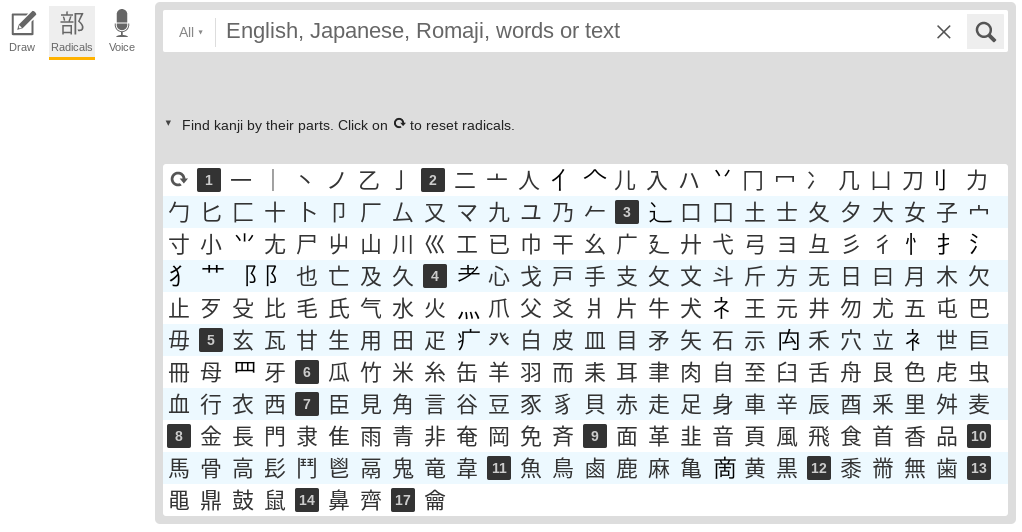
- Compose the kanji with the various radicals until it appears in one of the listed options.
Alternatively, if you cannot find the kanji on jisho:
- Go to Google Translate
- Use the handwriting tool to scribble something that looks similar to the
kanji you want, and look at the results. Google Translate is quite smart and
does not care much about accuracy or stroke order.
What does this word mean?
Check the dictionary:
What does this word mean?
Check the dictionary:
- Jisho is the best J-E online dictionary available.
- Weblio similarly to Jisho, it can often provide better and more flexible results. It’s definitely worth it to check both.
- Goo is a very useful J-J online dictionary.
- Nicovideo has a decent slang dictionary.
- And so does Pixiv
- Check the dictionary of onomatopoeias
What does this contraction mean?
Japanese has all kinds of contractions in speech which often leak into the
What does this contraction mean?
Japanese has all kinds of contractions in speech which often leak into the written form as well, for example では -> じゃ.
You can look at this amazing article for an explanation for many of them.
What does this particle or grammar structure mean?
- Use [Itazuraneko's grammar point aggregate](https://itazuraneko.neocities.org/grammar/masterreference.html)
What does this particle or grammar structure mean?
- Use Itazuraneko’s grammar point aggregate to search for the grammar point you are unsure about
- Search for
「<grammar>」意味on Google and read the (usually) Japanese results
What is the counter for this word?
- Search on google for `
What is the counter for this word?
- Search on google for
<word> 数え方 - Look up the word on benricho
What is the difference between these two words?
- Look up the words up in a J-E [dictionary](https://jisho.org)
What is the difference between these two words?
- Look up the words up in a J-E dictionary
- Look up the definitions for both words in a J-J dictionary
- This is very important because often the J-E dictionary won’t be detailed enough to point out nuances and slight differences between synonyms
- Google
「word1」 「word2」 どう違うand read the (usually) Japanese explanation - Use 7507c939 to check how the two words differ in context with real sentences and usage
What is the difference between this word written with these two different kanji?
This is what is called an 異字同訓 (ijidoukun).
What is the difference between this word written with these two different kanji?
This is what is called an 異字同訓 (ijidoukun).
Aside from following the steps from the question above this one, you can also look the most common ijidoukun on this site.
What words or particles should I use with this verb?
There is a website called [tsukuba web corpus](https://tsukubawebcorpus.jp/)
What words or particles should I use with this verb?
There is a website called tsukuba web corpus with a collections of all kinds of words/verbs taken from a bunch of native resources online.
The website breaks down how often words appear with a given particle, grammatical structure, collocation, etc.
You can check on the site if a certain phrase or sequence of particles for a given verb is acceptable/common/natural, and see its frequency in standard Japanese usage.
How to use the Tsukuba Web Corpus
-
Go to the tsukuba website (and bookmark it)
-
Set the language to English if you want
-
Click on Start Your Search
-
Type the word you want to look up in the search bar
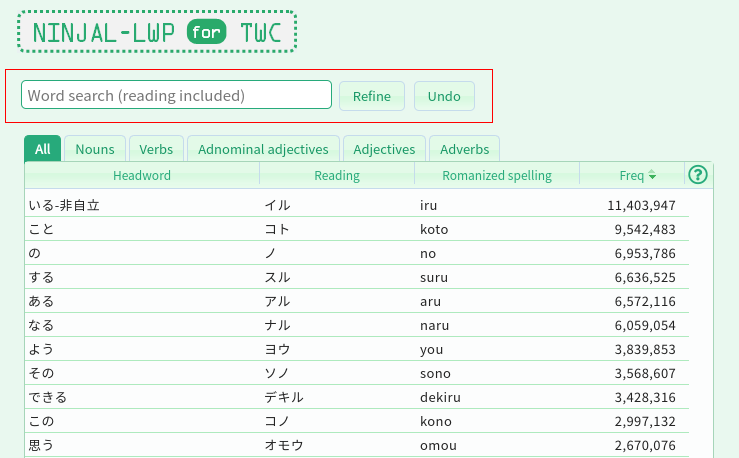
NOTE: する verbs count as a different word, for example 利用する (verb) is a different word from just 利用 (noun)
-
Click on the result to be brought to the collocations summary page
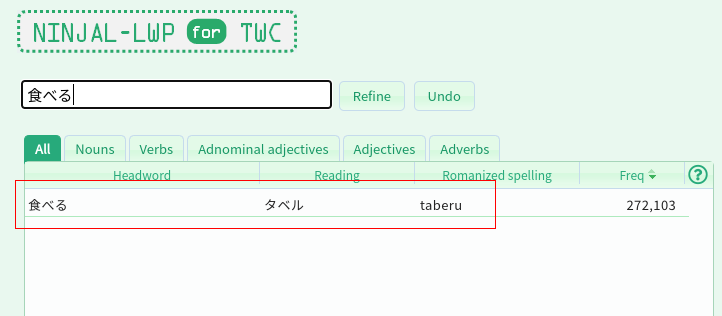
The Collocations Summary Page
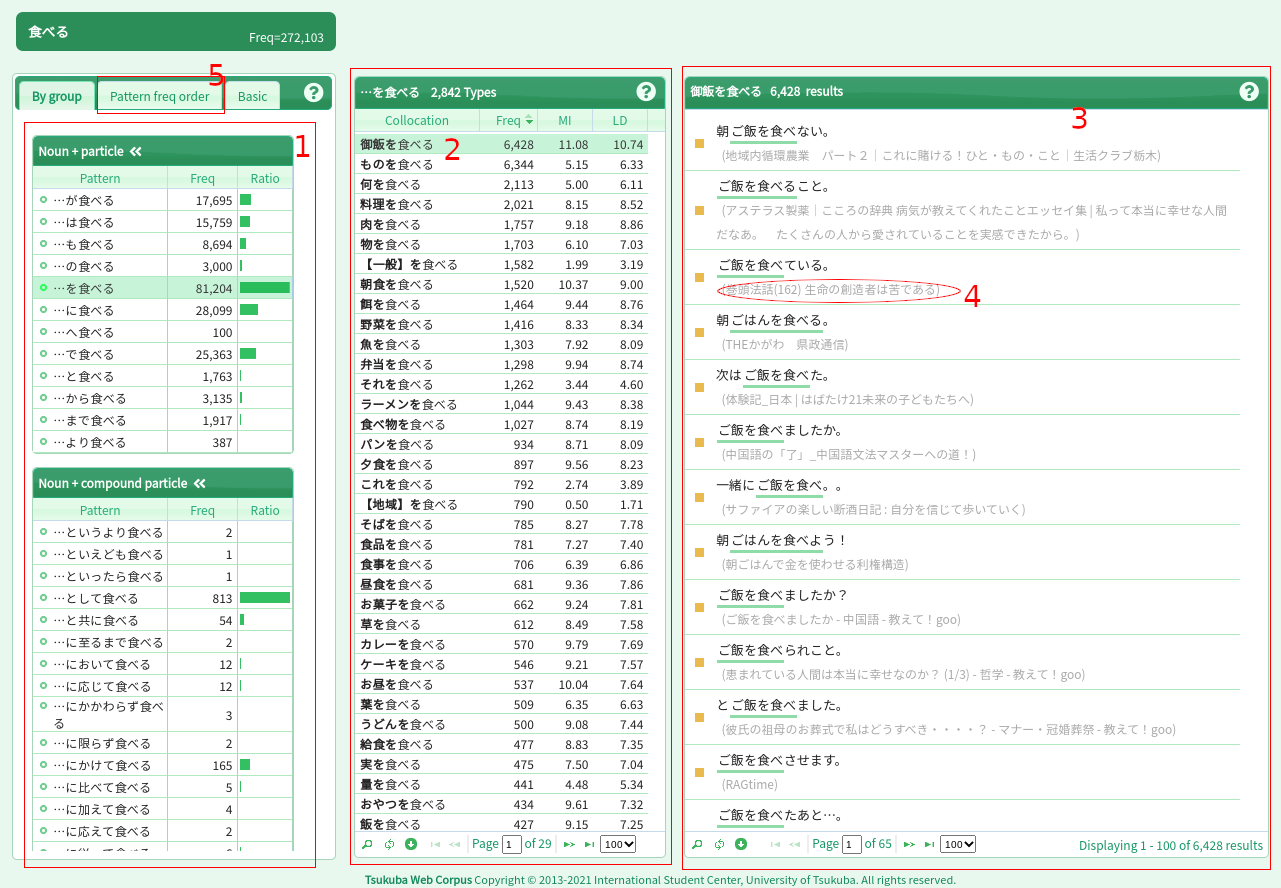
As you can see, the page can be quite daunting on a first look, so I made sure to highlight the important parts that you should be looking at, with a brief explanation:
- On the left side, there is a list of all grammatical patterns the searched word appears in. They are grouped/sorted by function (Noun + particle, Noun + compound particle, Auxiliary verbs, etc) and the numbers will show how many entries and how frequent a certain collocation appears in the corpus.
- After clicking on an entry in 1, in the middle, there is a list of the
relevant collocations of the searched word with the given pattern. For
example if you searched for を particle +
<verb>, it will show what kind of nouns will appear with を (e.g. 食べる -> 肉を食べる) - Click on an entry in 2 and the right side area will show a list of all the phrases with the actual usage of the word/pattern. It will also show the verb in its conjugated forms (食べる -> 食べない, etc)
- If you require context related to where the sample sentence came from, you can click on the area marked as 4 and it will bring up the source material
- If you click on the “Pattern freq order” tab, the left-most part will instead list all grammatical patterns for the searched word ordered by most to least amount of occurrences. It’s very useful if you want to quickly get a general idea.